


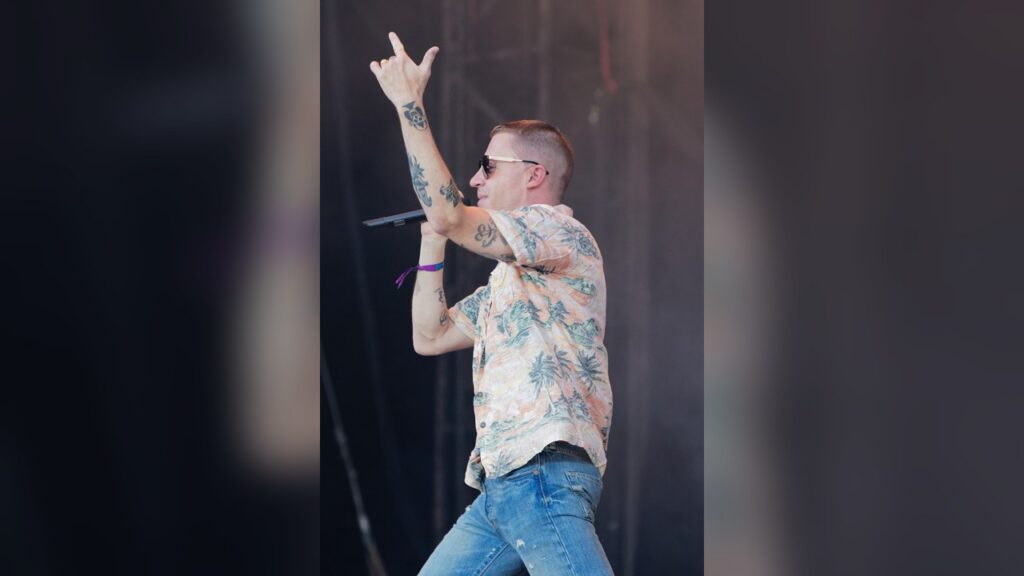
What we are witnessing is not, strictly speaking, a story about a rapper. It is a story about infrastructure. The infrastructure of cultural production in this country has always been owned, and the owners have always reserved the right to determine which political sentiments may pass through their gates. That this should surprise anyone in 2026 is, frankly, the more remarkable phenomenon.
Macklemore, born Benjamin Haggerty, performed “Hind’s Hall,” his anti-war song inspired by the 2024 Columbia University protests, at MetLife Stadium on September 4, opening for Ed Sheeran’s Loop Tour. He preceded it with a speech calling for a “Free Palestine” and, to his credit, addressed Jewish audience members directly to distinguish his criticism of the Israeli government from any animus toward them. This is a rhetorical move the literature on intergroup conflict resolution would recognize as a deliberate de-escalation gesture. It did not matter. Robert Kraft, the New England Patriots owner whose entertainment group controls Gillette Stadium, reportedly rallied other stadium owners to present Sheeran with an ultimatum: drop Macklemore or lose your venues. Sheeran’s promoter, Messina Touring Group, complied.
The structural pattern here is not novel. We have decades of scholarship on how capital concentration in media and entertainment produces a chilling effect on political speech that operates not through censorship laws but through contract law and venue access. No government agency told Macklemore he could not speak. A billionaire did, through the perfectly legal mechanism of threatening to withhold a stadium. The First Amendment, as any first-year constitutional law student can tell you, constrains the state, not the owner of a football arena.
Kraft, for his part, cited “a broader history of antisemitic rhetoric and imagery” from Macklemore, referencing without specificity a 2014 incident in which the rapper wore a costume to the Grammys that played on antisemitic tropes. Macklemore apologized at the time. The Anti-Defamation League accepted the apology. That was twelve years ago. Whether it constitutes a “broader history” is a characterization I leave to the reader, though I would note that the rhetorical move of collapsing a past offense into a present political position is one that scholars of social movements have documented across numerous advocacy contexts. It is effective precisely because it is difficult to contest without appearing to minimize the original harm.
What followed is the part that interests me. Every one of Sheeran’s remaining support acts, Finneas, Lukas Graham, Aaron Rowe, and his backing band Beoga, withdrew from the tour in solidarity. Sheeran took the stage in Philadelphia alone, tearfully telling the crowd he had “never wanted to be an activist musician” but that “this has put me in the middle of an important and passionate argument about freedom of speech.” He called the October 7 Hamas attack “horrific” and the Gaza campaign “catastrophic and unjustifiable and disproportionate.” Ticket prices for the tour plummeted.
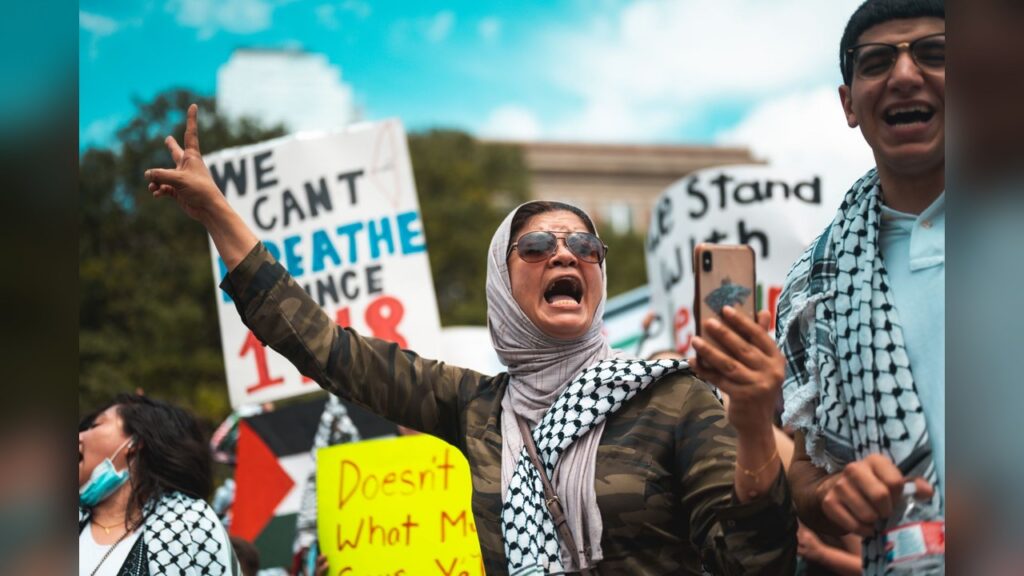 Alfo Medeiros / Pexels
And Macklemore, whose schedule had indeed freed up, announced the Free Palestine Tour: Dublin on October 26, Paris on October 29, London on October 30, with U.S. dates to follow. All proceeds benefit organizations supporting Palestinians. He has spent the week contacting other artists. None have been named yet.
“It’s 2026,” he wrote. “Being apolitical during a genocide doesn’t work anymore.”
One need not accept every framing Macklemore employs to recognize that he has correctly identified the mechanism. When the billionaire class can decide which voices are allowed on stage and which ones are too dangerous to hear, the stage is not a public square. It is a privately owned space governed by private interests, and the speech permitted within it is bounded not by principle but by the balance sheet. This is not a scandal. It is a system operating exactly as its property relations dictate. The question is whether we find that system acceptable, and whether we will continue to pretend that a culture mediated entirely through billionaire-owned infrastructure can produce anything resembling a genuine public discourse.
Sheeran, to his partial credit, said he was “deeply worried about the idea that venues pre-approve content for performers.” One wishes he had been worried about it before his promoter made the call rather than after. But that, too, is how structural incentives work. The person inside the machine is rarely the one who can stop it.