


There is a well-documented phenomenon in the political science literature, and it might be called the gap between symbolic patriotism and distributive commitment. Scholars have spent decades cataloguing it. The politician who delivers the soaring tribute at the memorial ceremony is, with depressing statistical regularity, the same politician who voted against the appropriations bill that would have given the people being memorialized access to an oncologist. Mike Rogers, the Republican nominee for Michigan’s open Senate seat, has provided what amounts to a textbook illustration of this gap, and he has done so with a precision that borders on the instructional.
Consider the sequence. On Wednesday, Rogers posted a video about Capt. David Nadeau, a Monroe Charter Township firefighter who drove to Ground Zero on the evening of September 11, 2001, and now has cancer. “Nobody deserves this,” Rogers wrote. A moving sentiment. One might even call it sincere, were it not for the congressional record sitting right there in the open, unmoved by sentiment.
In 2010, Rogers voted against the James Zadroga 9/11 Health and Compensation Act, which funded medical monitoring and treatment for first responders and survivors exposed to toxic conditions at Ground Zero. The program has since served nearly 155,000 people. Rogers voted against it not once but twice. During a House Energy and Commerce Committee debate, he warned that guaranteeing healthcare for these people would “jeopardize the financial health of the United States of America.” The World Trade Center Health Program cost $4.2 billion over a decade. Rogers has not, for the record, expressed comparable fiscal alarm over the $37.5 billion spent on President Trump’s Iran operation since February.
John Feal, a first responder advocate who spent 11 weeks hospitalized after a steel beam crushed his foot at Ground Zero, told The Guardian he personally discussed the Zadroga legislation with Rogers on the House floor. Rogers, Feal said, told him the health issues were a “New York problem” and asked where the money would come from. Feal called it “a betrayal.” Henry Yanez, a retired Michigan firefighter who went to New York after the attacks, put it more plainly: “Mike Rogers. Shame on him.”
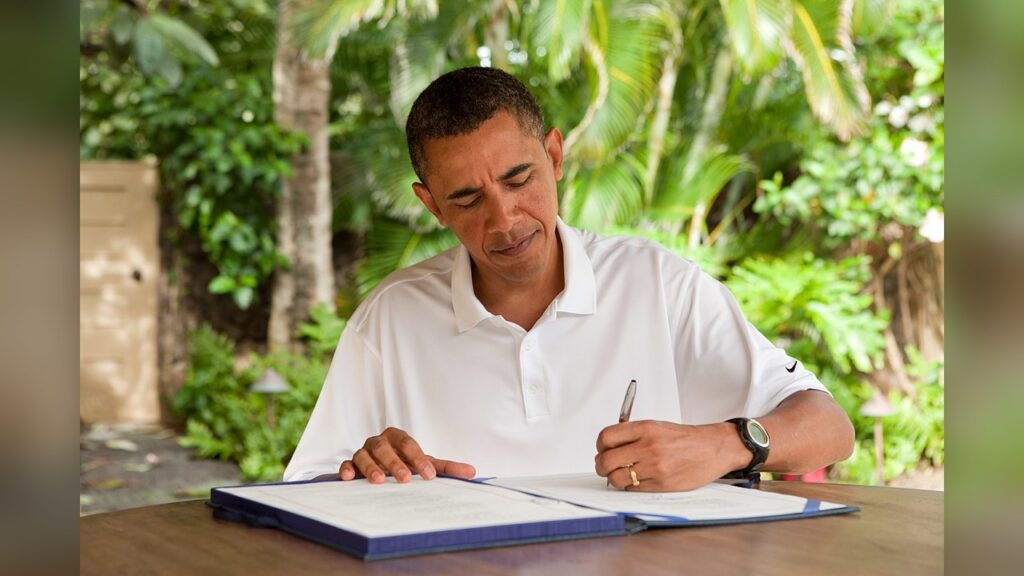 Pete Souza (Public domain) via Wikimedia Commons
But the structural pattern here runs deeper than a single voting record, and this is where the analysis requires some patience. Rogers has not merely neglected first responders. He has actively converted 9/11 into an instrument of ethnic and religious mobilization against his opponent. The day after Abdul El-Sayed won the Democratic primary, Rogers claimed El-Sayed “believes America deserved 9/11.” He does not. FactCheck.org investigated and found the claim false. The remark Rogers attributed to El-Sayed actually came from a left-wing streamer named Hasan Piker, who made the comment in 2019 and later retracted it. El-Sayed has repeatedly and explicitly denounced the statement. Rogers’s campaign, confronted with this, simply doubled down, with spokesperson Alyssa Brouillet calling Piker the “unofficial spokesman” for El-Sayed’s campaign, which is also false.
Rogers also wrote in a fundraising email that he “saw the dead body of Osama bin Laden with my own eyes.” He was not in Pakistan. He was not in the Situation Room. The claim does not survive even cursory scrutiny.
What we are observing is not, in the analytical sense, a scandal. A scandal implies a deviation from norms. This is something more systematic: the operationalization of national trauma as a political resource, deployed selectively against a Muslim opponent while the material needs of the actual victims of that trauma are treated as a budgetary inconvenience. The Center for the Study of Organized Hate found that anti-Muslim posts targeting El-Sayed surged twentyfold after his primary victory. Rogers is not a bystander to that surge. He is one of its engines.
There is a term in the literature for political actors who invoke the sacrifice of others to obscure their own refusal to bear the cost of that sacrifice. The term is “opportunist.” Rogers has earned it with a thoroughness that should dispel any remaining ambiguity.