

Treasury Secretary Scott Bessent walked onto Fox News Wednesday to announce that the U.S. and China will extend their “Busan Agreement” trade truce through January 10. The deal, originally set to expire November 10, pauses escalating tariffs and was negotiated at a Trump-Xi summit in Busan, South Korea, last year. Bessent called the talks “very productive.” He said a larger economic package might come by January, or they might “just roll the current deal” further down the line.
Notice the language. “Just roll the current deal.” That is the voice of an administration comfortable with managed stagnation, where the only stakeholders who matter are the ones already in the room.
And who is in the room? Bessent. U.S. Trade Representative Jamieson Greer. Chinese Vice Premier He Lifeng. Two presidents. The entire negotiation was conducted between Sunday and Wednesday by a handful of cabinet-level officials and their counterparts, with zero public input, zero worker representation, zero community consultation. The announcement landed minutes after Xi Jinping touched down for a state visit, his first U.S. trip since 2015. The optics were choreographed. The substance was thin.
Bessent himself admitted the problem. “There are some deliverables that have not been perfect on the Chinese side,” he said. So we are extending a truce that the other party has not fully honored, on the hope that over “the coming months they can be more fulsome in enacting the agreement.” That is not accountability. That is a deadline pushed back with a polite request stapled to it.
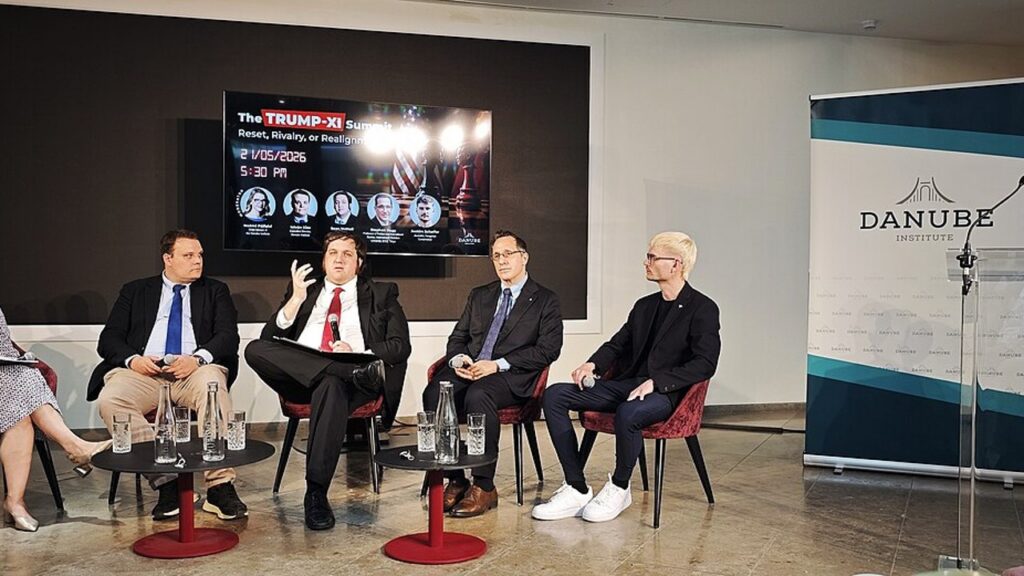 Elekes Andor (CC BY 4.0) via Wikimedia Commons
The areas Bessent highlighted for potential further agreement tell you exactly whose interests this deal serves: agricultural products and financial services. Agribusiness conglomerates and Wall Street firms. Not the line worker whose job moves with tariff schedules. Not the small business owner absorbing supply chain costs. Not the family budgeting around grocery prices that swing with every round of trade brinkmanship.
Every time these two governments sit down, the framing is the same. “Economic stability for millions of consumers and businesses.” Stability is a word that sounds neutral until you ask: stable for whom? Stable for the investor class that watches tariff headlines from a trading floor. Stable for the executives who pass cost increases downstream. The millions of workers who actually absorb the shock of trade disruptions, who lose jobs when factories relocate, who pay more when tariffs hit consumer goods, they are never at the table. They are the table.
The Busan Agreement paused tariffs. That is real and it matters. Escalating trade wars hurt working communities first and worst. But a pause is not a plan. An extension is not a solution. And a process that locks out labor, locks out community voices, and locks in corporate priorities is not democratic trade policy. It is backroom deal-making dressed up as diplomacy.
What must happen now is