


Donald Trump sat in the Oval Office on Friday afternoon and told the country, with the casualness of someone ordering lunch, that he was banning CNN, MS NOW, and Politico from the White House. “I don’t want them in my office,” he said. “I don’t want them here.” He posted it on Truth Social first, of course, because that’s where this president goes to announce things he knows he can’t legally do. “Effective immediately,” he wrote, accusing the three outlets of “constant ‘reporting’ FAKE NEWS!” He named no examples. He cited no stories. When a reporter asked him why he chose Friday, he said, “No reason.”
There is always a reason. The reason is that scrutiny is the one thing this administration cannot tolerate. The reason is that a press corps asking questions is a check on power, and this president has spent his entire political career trying to remove every check that exists. He banned the Associated Press from Oval Office events last year because they wouldn’t call the Gulf of Mexico the “Gulf of America.” That case is still in court. His administration has gone after the New York Times, the Wall Street Journal, the BBC, and ABC’s broadcast licenses. The White House seized control of the press pool from the White House Correspondents’ Association. The Treasury Department denied credentials to journalists covering the G20. This is not a man lashing out. This is a strategy, executed step by step, to make sure the only people holding cameras near him are people who won’t point them at anything that matters.
And then there was Pete Hegseth, applauding from the sidelines, posting that the “Department of War fully supports” kicking these outlets “to the curb.” The Department of War. That’s what he called it. The renaming itself is a tell about where this crowd wants to take things, but the sentiment is the real headline: a Cabinet official cheering the president’s attempt to exile news organizations for the content of their coverage. That is viewpoint discrimination. It is the textbook definition of what the First Amendment prohibits.
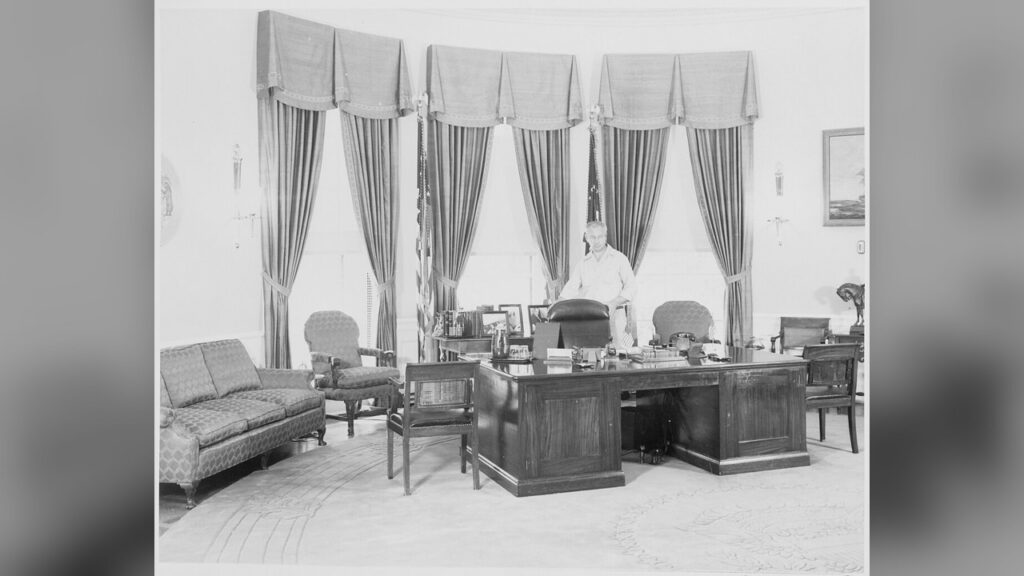 Abbie Rowe (Public domain) via Wikimedia Commons
The courts have said this already. In 1977, a federal appeals court ruled in Sherrill v. Knight that once the White House opens press facilities to journalists, it cannot deny access based on what they publish. Bruce D. Brown of the Reporters Committee for Freedom of the Press called the ban “flatly unconstitutional.” Seth Stern of the Freedom of the Press Foundation said it was “difficult to imagine a more blatant violation of the First Amendment.” Jameel Jaffer of the Knight First Amendment Institute noted that with so many courts ruling against Trump on exactly this point, you’d think he’d have learned. He hasn’t, because learning was never the point. The point is the spectacle. The point is making reporters, editors, and entire newsrooms spend their time and money fighting in court instead of doing the work the public needs them to do.
CNN’s team was still in the White House press workspace Friday evening. A CNN crew was traveling with Vice President JD Vance as the assigned television pool. Politico’s reporters were still on the grounds. The ban, as of Friday night, was a Truth Social post and an Oval Office tantrum with no enforcement mechanism behind it. But the threat is the mechanism. The threat is what makes editors second-guess a story, what makes a reporter hesitate before filing, what makes an outlet wonder if access is worth the fight. That is the harm. That is always the harm.
Chuck Schumer said it plainly: “Donald Trump just did what dictators throughout history have done.” He’s right, and the response can’t stop at statements. Every news organization in this country, whether targeted or not, needs to treat this as an attack on the entire press. Legal challenges must come immediately and in force. Congress must hold hearings. Bar associations, journalism schools, press freedom groups, and every citizen who understands that an uninformed public is an unarmed one needs to raise the cost of this behavior until it becomes too high to sustain. The First Amendment is not a suggestion. It is the architecture of accountability. When the most powerful person in the country tries to tear it down, the answer is not to wait and see. The answer is to stand up, together, and refuse to move.