



There is a particular kind of policy gesture, familiar to anyone who has studied fiscal management in failing states, that involves addressing the symptom with tremendous public confidence while the disease continues metastasizing in the next room. Treasury Secretary Scott Bessent’s announcement on Wednesday that the federal government will at least double its bond buyback operations, lifting the per-operation ceiling from $2 billion to $4 billion, belongs squarely in that tradition.
The 30-year Treasury yield crossed 5% this week. That is the highest level since 2007, a year that ought to concentrate the mind of anyone with a passing acquaintance with financial history. The 10-year is not far behind. Long-term borrowing costs across the G7 have surged in sympathy: UK 30-year rates near 1998 levels, Japanese borrowing costs at their highest since 1996, France at a 16-year peak. This is not a localized disturbance. It is a global repricing of sovereign risk, and the United States is its epicenter.
Bessent’s buyback plan did produce a rally. For several hours. By Thursday, yields were climbing again, reversing most of the move. Lori Heinel, global chief investment officer at State Street Investment Management, described the intervention as “a drop in the bucket relative to the other pressures on yields.” Mark Sobel, a longtime Treasury official now at the Official Monetary and Financial Institutions Forum, was less diplomatic: “Our massively irresponsible fiscal policy is the root cause of the sustained rise in longer term yields. Increasing buybacks is akin to spitting into a gale force wind.”
One does not need to be a structural economist to grasp the problem, though it helps. The national debt has crossed $40 trillion for the first time, having doubled in a decade. The Trump administration’s tax and spending plans are, by the assessment of its own former officials, unsustainable. The war with Iran has pumped up oil prices, feeding inflation expectations at precisely the moment when central banks are expected to tighten. And the new Fed chair, Kevin Warsh, has declined to provide the forward guidance that bond markets have grown accustomed to receiving, which is his prerogative but hardly calming.
Into this concatenation of forces, the Treasury has offered a liquidity operation scheduled to run from September 9 through November 4. The terminal date is, of course, the day before the midterm elections. Jessica Riedl of the Brookings Institution noted this with admirable restraint: “I think that motivates Treasury, particularly before an election, to try to tamp down the markets and the news cycle before this becomes a more potent political issue.” Only 29 percent of voters approve of Trump’s handling of the economy, per Reuters/Ipsos. The political incentive structure is not subtle.
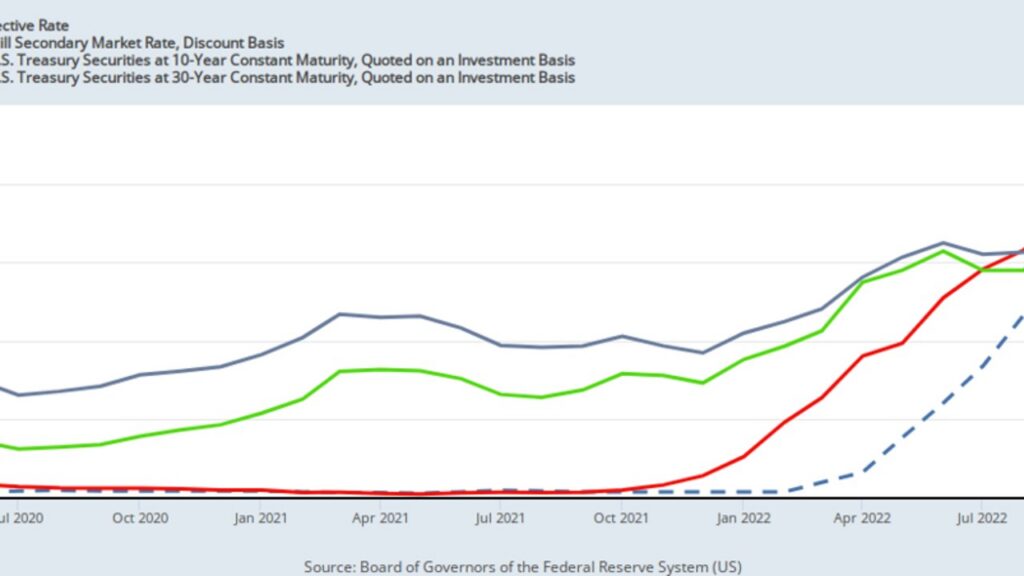 Federal Reserve Economic Data (Public domain) via Wikimedia Commons
Trump himself addressed the volatility on Wednesday with his characteristic analytical precision. “Our country is doing so well despite interest rates,” he said after meeting technology executives. “We’re powering through these ridiculous rates.” One notes that the rates are not ridiculous in the sense of being inexplicable. They are the market’s rational assessment of the fiscal trajectory. Calling them ridiculous is rather like describing a thermometer as hysterical.
Albert Edwards of Société Générale, who has built a career on predictions that eventually prove less eccentric than they sounded at the time, observed that the last time French and U.S. long bond yields sat at these levels was around 2007, and for Japan and the UK, 1997. Both years preceded catastrophic financial crises. He is not alone in noting the parallel. The conditions for a market accident, as he put it, are coming together.
The deeper structural issue, and I confess to some exhaustion in having to repeat it, is that the United States has enjoyed what economists call an “exorbitant privilege”: the dollar’s reserve status has allowed persistent trade and budget deficits without the disciplinary pressure other sovereigns face. That privilege is not a law of nature. It is a function of institutional credibility, fiscal coherence, and policy predictability. An administration that wages an inflationary war, runs $40 trillion in debt, and responds to a bond market sell-off with a $4 billion buyback and a press conference is testing each of those foundations simultaneously.
Adam Josephson of Sakonnet Research perhaps put it most cleanly: “They’re trying everything possible to limit upward pressure on long-term yields. Nothing has worked. And why would this work? It’s too small to matter.”
When the former officials of your own department describe your policy as spitting into a gale, the gale is the story, not the spitting.