


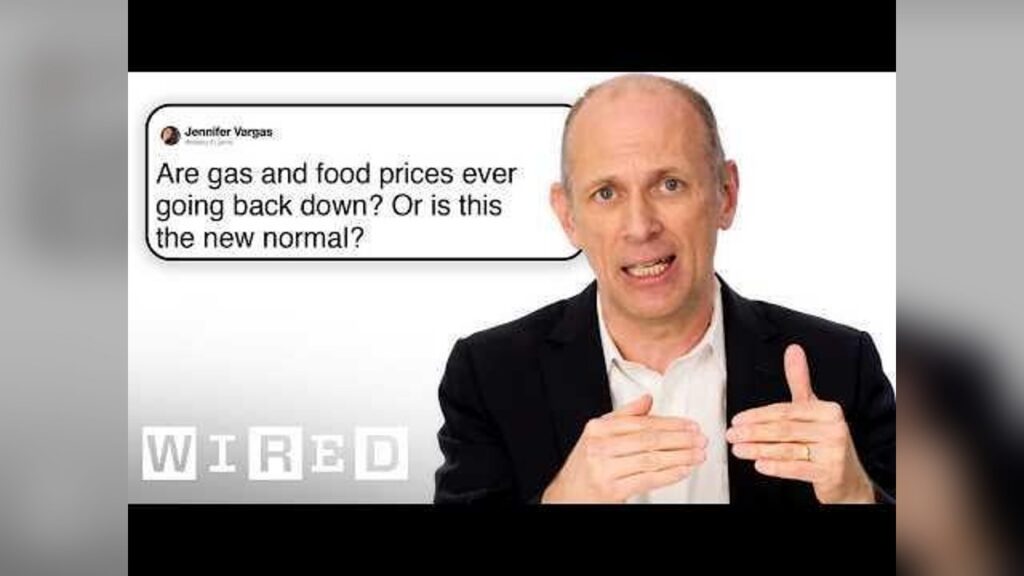
There is something quietly remarkable about Austan Goolsbee sitting in front of a camera for WIRED’s “Tech Support” series, patiently explaining how the Federal Reserve works to an audience that, statistically speaking, has already formed its opinions from a meme. The President of the Federal Reserve Bank of Chicago devoted a half-hour to fielding internet questions about the American economy, and the exercise is best understood not as a media appearance but as a structural artifact: a central banker attempting to repair, one video at a time, several decades of catastrophic public economic illiteracy.
Consider what he was up against. One questioner asked whether the Fed is “really just a private bank” or “secretly owned by the government,” because, the reasoning went, “they print money whenever they want.” This is not a fringe view. This is the baseline. A nontrivial share of the American public believes the Federal Reserve is a shadowy cabal operating outside democratic accountability, a theory that conflates institutional independence with secrecy and mistakes the deliberate insulation of monetary policy from electoral pressure for a conspiracy. Goolsbee, to his credit, did not sigh audibly. He explained that the Fed is part of the government, that the Federal Reserve Act was designed to insulate rate-setting from political interference, and that yes, overprinting money causes inflation, which is rather the entire point of having a central bank in the first place.
He also noted, almost casually, that the Chicago Fed vault holds “many tens of billions” of dollars in cash, that the Fed functions as essentially an ATM for commercial banks, running hundreds of millions in and out daily, and that worn bills are shredded into confetti. He showed how to detect counterfeit hundreds. He displayed a two-by-four that angry citizens mailed to Paul Volcker in the early 1980s when the federal funds rate exceeded 20%, inscribed with the words “Please lower these insane interest rates.” Goolsbee keeps it in his office. It is, one suspects, the closest thing the Federal Reserve has to a relic of popular martyrdom.
 See-ming Lee from New York, NY, USA (CC BY-SA 2.0) via Wikimedia Commons
The housing answer was the one that mattered most. Goolsbee told his questioner, gently, that the Fed does not control mortgage rates, that housing has been getting structurally more expensive relative to goods for 20 to 40 years, and that if you want prices to go down you have to build more housing. This is not controversial among economists. It is, however, controversial among every homeowner who treats their property value as a sacrament and every local zoning board that treats a three-story apartment building as an existential threat. The constraint is not monetary policy. The constraint is political. We have built a country where the same people who complain about housing affordability show up at city council meetings to oppose the construction of housing.
What Goolsbee was doing on WIRED was not public relations. It was remedial education delivered at a moment when the institution he represents is under sustained ideological assault from both directions, from the right’s gold-standard nostalgists and the left’s modern monetary theorists, neither of whom, it bears noting, have ever had to manage a payment system that processes hundreds of millions of dollars in physical cash per day. The Federal Reserve has genuine failures worth scrutinizing. Its track record on inflation forecasting in 2021 was poor. Its regulatory posture toward regional banks before Silicon Valley Bank collapsed was complacent. These are real critiques. “Is the Fed secretly a private bank” is not one of them.
The tragedy is not that Goolsbee had to do this. The tragedy is that it will not be enough.
 Tolga deniz Aran / Pexels