


There is a certain clinical elegance to what we are witnessing in Minnesota, and I say that not as a compliment. Mike Lindell, the pillow magnate turned election-theory industrialist, lost the Republican primary for governor on August 11 by 11 percentage points to Lisa Demuth, the speaker of the Minnesota House. Eleven points. That is not a margin that invites ambiguity. That is a margin that, in the political science literature, we classify as a “clear and decisive result,” a category reserved for outcomes where the winner’s vote share exceeds the loser’s by a threshold sufficient to eliminate any reasonable doubt about the electorate’s intent.
Lindell, predictably, has declined to occupy the category.
Instead, he has announced his intention to personally fund a statewide hand recount and audit, at an estimated cost of $825,000, which CBS News reports would make it the largest privately funded paper-ballot recount in American history. Minnesota law, it should be noted, automatically triggers a recount when the margin between candidates falls within 0.25 percentage points. Lindell’s deficit sits at roughly 44 times that threshold. The statute, in other words, was designed precisely for situations like this, and it is functioning exactly as intended: no automatic recount, because no reasonable system would order one.
 Lisa Demuth for Governor (CC0) via Wikimedia Commons
What we are observing is not a failure of election infrastructure. It is the deliberate theatrical rejection of that infrastructure by a candidate who has built an entire public identity around the premise that American elections are structurally illegitimate. Lindell famously promoted claims that the 2020 presidential election was rigged, assertions that drew a $1.3 billion defamation lawsuit from Dominion Voting Systems, now rebranded as Liberty Vote. That suit settled in July for an undisclosed sum. One might have imagined the experience of being sued into a quiet settlement by a voting-machine company would introduce some epistemic humility. One would be wrong.
Lindell has cited specific grievances: counties reporting more votes than were cast, vote totals that “moved backward,” and suspiciously synchronized numbers across all seven Republican candidates. These are the kind of claims that sound alarming in a press release and dissolve under the most rudimentary scrutiny, the sort that county election administrators perform as a matter of daily routine and that academic researchers have studied exhaustively. The literature on perceived election fraud is quite clear on this point: the strongest predictor of whether an individual believes an election was stolen is not evidence of irregularity but whether their preferred candidate lost. Lindell is not an outlier. He is a textbook case.
What makes this particular episode worth noting is the cost. Not merely the $825,000, though that is not trivial for a man who stepped down as CEO of My Pillow in early August to pursue this race. The deeper cost is institutional. Every privately funded recount premised on unsubstantiated claims normalizes the idea that election results are merely provisional suggestions, subject to renegotiation by whoever has the capital to challenge them. Minnesota’s election administrators will now devote weeks of labor to hand-counting ballots that a decisive primary already settled, because a man who lost by 11 points has the resources to insist otherwise.
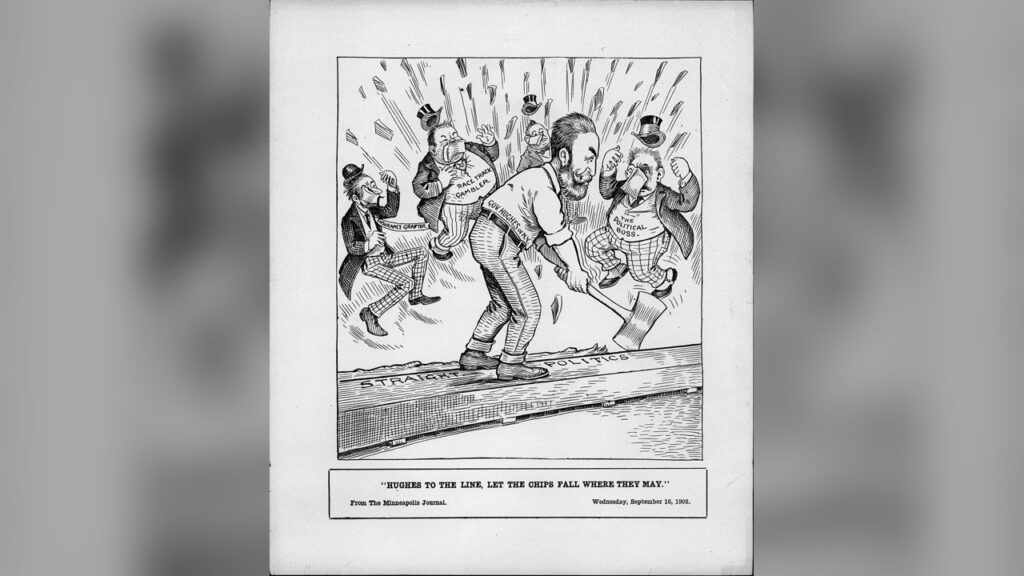 Bartholomew, Charles Lewis 'Bart', 1869-1949 (Public domain) via Wikimedia Commons
The system, to be clear, will hold. The recount will confirm what the initial count already established. Lisa Demuth will be the Republican nominee. The ballots will match. The anomalies will turn out to be rounding artifacts, reporting delays, or the ordinary administrative friction that accompanies any large-scale democratic process. And Mike Lindell will, in all likelihood, decline to accept that outcome as well.
That is the real story here, and it is not about Minnesota. It is about a political culture in which conceding defeat has become optional, not because the evidence is ambiguous but because the financial and reputational incentives have been structured to reward denial. When losing an election by 11 points is treated as a plot rather than a verdict, the threat is not to any single race. It is to the shared epistemic foundation on which the entire enterprise of self-governance rests. And that, I am afraid, is not something a recount can fix.