



The political press has settled on a familiar frame for Rep. John Larson’s primary defeat on Tuesday: “anti-incumbent fervor,” a “bruising primary season,” a wave of voter dissatisfaction. One almost hears the sigh in the copy. Ten House members felled in their own primaries this cycle, seven Democrats and three Republicans, plus two Republican senators for good measure, and the preferred adjective is “unusually high.”
It is not unusually high. It is, if anything, overdue.
 Ragesoss (CC BY-SA 3.0) via Wikimedia Commons
Larson, 78, had served nearly three decades in Congress after more than a decade in the Connecticut state legislature. That is not a résumé. That is a sedimentary deposit. He was backed by House Minority Leader Hakeem Jeffries, by the state’s congressional delegation, by the major unions, by every institutional scaffold the Democratic Party could erect around a sitting member. Former Hartford Mayor Luke Bronin, 47, out-raised him anyway, won over the party activists who actually do the precinct-level labor, and carried 54 percent of the vote to Larson’s 33 percent. Two additional candidates split the remaining 13 percent, which is to say that two-thirds of Democratic primary voters in Connecticut’s 1st District wanted someone other than the man who had represented them since 1999.
The literature on this is not ambiguous. In their 2022 analysis of congressional incumbency advantage, political scientists found that the protective machinery of the modern House, the leadership endorsements, the DCCC’s de facto veto over competitive primaries, the fundraising networks that reward seniority over ideas, has functioned as a cartel mechanism, suppressing the competitive turnover that any healthy legislative body requires. The median age of House Democrats is now north of 65. The median age of the American population is 38.9. That gap is not a statistical curiosity. It is a structural failure, and the voters who showed up in Hartford on Tuesday are correcting it through the only mechanism available to them: the primary.
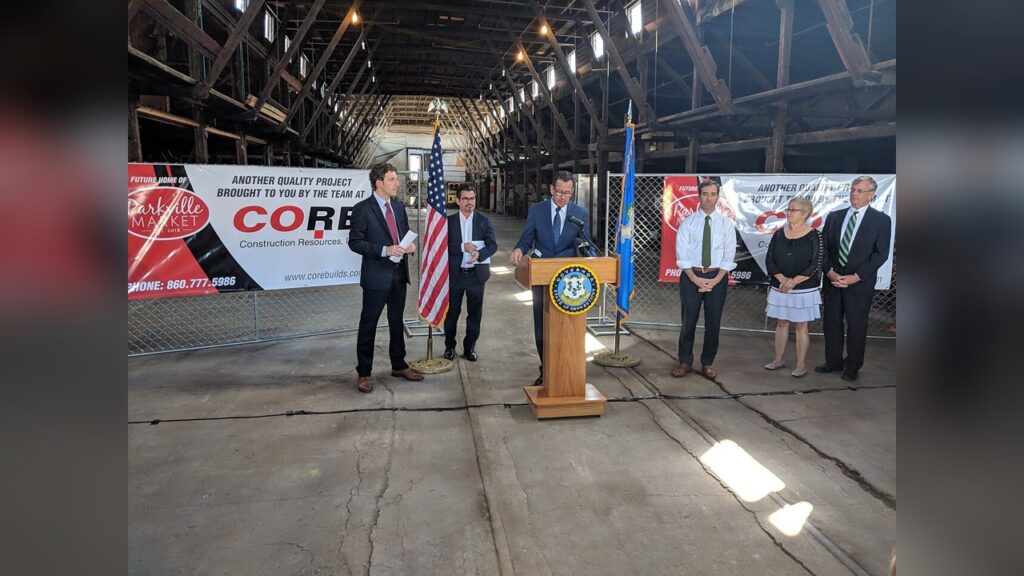 Dannel Malloy (CC BY 2.0) via Wikimedia Commons
What is striking about the Larson-Bronin race, and what the breathless “anti-incumbent” framing obscures, is that this was not an ideological purge. Roll Call noted that the primary did not cleave along left-versus-moderate lines. Bronin did not run to Larson’s left so much as he ran against the idea that a congressional seat is a tenured chair with no review process. The argument was generational, and it was correct. When a 78-year-old member who entered Congress during the Clinton administration insists he is the best person to confront the institutional crisis of Trump’s second term, the burden of proof should be enormous. Larson could not meet it.
One expects the hand-wringing to continue. The same commentators who spent 2024 lamenting the Democratic Party’s leadership vacuum will now lament the removal of the leaders who created the vacuum. This is the circular logic of institutional self-preservation: the party cannot change because the people who would have to authorize the change are the people the change would remove.
 Paul Danese (CC BY-SA 4.0) via Wikimedia Commons
Twelve incumbents down across both parties, and the commentariat calls it a crisis. The rest of us might call it a curriculum.