


There is a temptation, when a federal agent shoots an unnamed man in the torso on a Sunday afternoon in north Austin, to treat it as an aberration. A procedural hiccup. A regrettable but isolated incident in the 7000 block of West Anderson Lane, soon to be resolved by the appropriate mechanisms of oversight. I would gently encourage you to resist that temptation, because the data do not support it.
What happened in Austin is not a malfunction. It is a predictable output of a system operating at capacity. ICE is currently producing more than 50,000 arrests per month, the first time in the agency’s history it has sustained that volume, in July and August. When you scale any enforcement apparatus that aggressively, you do not get more efficiency. You get more contact. More contact produces more confrontation. More confrontation produces more gunfire. This is not speculation. It is the basic arithmetic of state force applied at industrial scale.
Consider the recent sample. In July, an ICE officer fatally shot Lorenzo Salgado Araujo, 52, in Houston, after federal agents in unmarked vehicles pursued him while he was driving his construction crew to a job site. Also in July, an ICE officer shot Johan Sebastián Durán Guerrero, a 25-year-old Colombian man, in Maine. That officer, several of his own relatives told the Associated Press, is an Army veteran who has struggled with serious mental health issues since early childhood and, in their assessment, should never have been issued a badge. The administration’s enforcement surge was already under scrutiny after the killings of Alex Pretti and Renee Good in Minnesota last winter. Austin is not an outlier. Austin is a data point in a trend line.
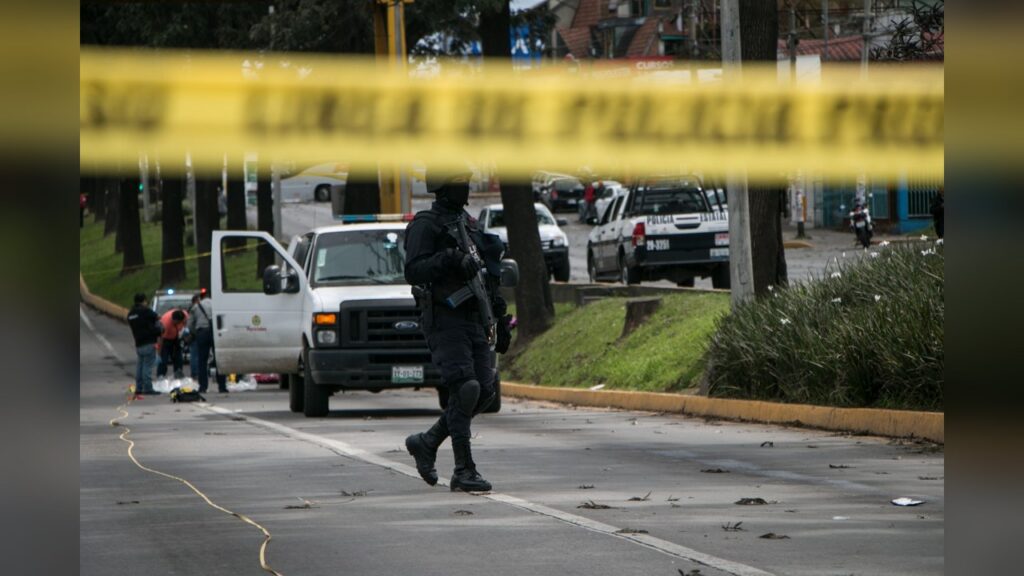
The details from Sunday remain, as Chief Lisa Davis frankly acknowledged, thin. What we know: an ICE officer conducted a traffic stop. A foot pursuit followed. The man was shot once in the torso. He is in serious but stable condition. Austin police were not involved. A dark blue Toyota Corolla sat under an overpass with damage to its passenger-side door and what appeared to be bullet holes. City Council member Mike Siegel, citing CBS News, alleged that the ICE officer rammed the man’s car before exiting his vehicle and firing at least five rounds. That claim requires verification. It also requires an investigator who does not work for ICE.
 Kindel Media / Pexels
Mayor Kirk Watson, to his credit, grasps this. He has asked Austin’s police department to provide what he called “clear, third-party eyes,” and he has said, with commendable understatement, that he does not think it would be appropriate for ICE to investigate itself. One might extend that logic: no institution should be permitted to adjudicate its own use of deadly force. This is not a radical proposition. It is the foundational principle of independent oversight, and the fact that it requires stating aloud in 2026 tells you something about the institutional rot.
The Department of Homeland Security, which oversees ICE, did not attend the news conference and did not respond to requests for details. The mayor does not know where the involved agent is. He hopes the agent has not left the city. One hopes. Hope, of course, is not a mechanism of accountability.
About a hundred protesters gathered at the scene. Some cursed at officers holding riot shields. Passing cars honked in support. Representative Greg Casar called for transparency and said ICE should end its surge in Austin. Fox News, for its part, urged caution about early claims circulating on social media, which is a reasonable impulse that happens to serve, in this instance, the convenient function of deferring scrutiny until the news cycle moves on.
The literature on paramilitary enforcement expansion is unambiguous. When you militarize an agency, saturate a jurisdiction with agents who have limited local accountability, and set production quotas that reward volume over precision, the rate of violent encounters does not decline. It climbs. Austin is not the exception that proves the rule. Austin is the rule, arriving on schedule, and it will arrive again.