



A Federal Judge Just Explained Title VI to the Justice Department. Slowly.
There is a particular species of governmental overreach that announces itself not as power but as principle. The Trump administration’s lawsuit against Harvard University, filed in March and dismissed Thursday by Judge Richard G. Stearns of the U.S. District Court in Massachusetts, belonged to that species with unusual purity. It draped itself in the language of civil rights enforcement while seeking a remedy, the retroactive clawback of nearly $1 billion in federal grants, that bore no plausible relationship to the statutory framework it invoked. Judge Stearns, in a brisk four-page decision, performed the service of explaining this to the Department of Justice as one might explain it to a first-year student who had not done the reading.
 United States District Court for the District of Massachusetts (Public domain) via Wikimedia Commons
The legal theory was straightforward in its ambition and wobbly in its foundation. The government alleged that Harvard had been deliberately indifferent to antisemitism on campus following the Hamas attacks of October 7, 2023, and that this indifference constituted an ongoing violation of Title VI of the Civil Rights Act. The remedy sought was extraordinary: not merely prospective compliance, but the confiscation of grants already awarded and the severance of all future federal funding. What the government could not do, as Stearns observed with the patience of a man who has explained this before, was point to any factual basis for claiming that Harvard remained in violation of Title VI at the time the suit was filed. The amended complaint leaned almost entirely on incidents from the 2023-24 academic year. It cited exactly three incidents from March 2025. After the government issued its formal statutory notice on June 30, 2025, the complaint offered nothing at all. “Devoid of any factual allegations” is not a phrase a federal judge deploys lightly.
What makes this more than a routine pleading failure is the structural context, which Stearns addressed with characteristic precision. Title VI enforcement, as the statute and its accompanying regulations make clear, exists to secure future compliance, not to punish past misconduct. Congress designed it as an incentive mechanism: notify the recipient, attempt voluntary compliance, and only then, if compliance cannot be secured, escalate to enforcement. The Justice Department argued that requiring an ongoing violation would make Title VI suits “virtually impossible” to win, since a defendant could simply come into compliance once threatened. Stearns rejected this with the dry observation that the government “misconstrues” the purpose of the statute. Congress, he wrote, “did not intend to penalize a wayward funding recipient but instead to incentivize it to bring itself into compliance.” This is not a close question. It is, one might say, the entire architecture of the Act.
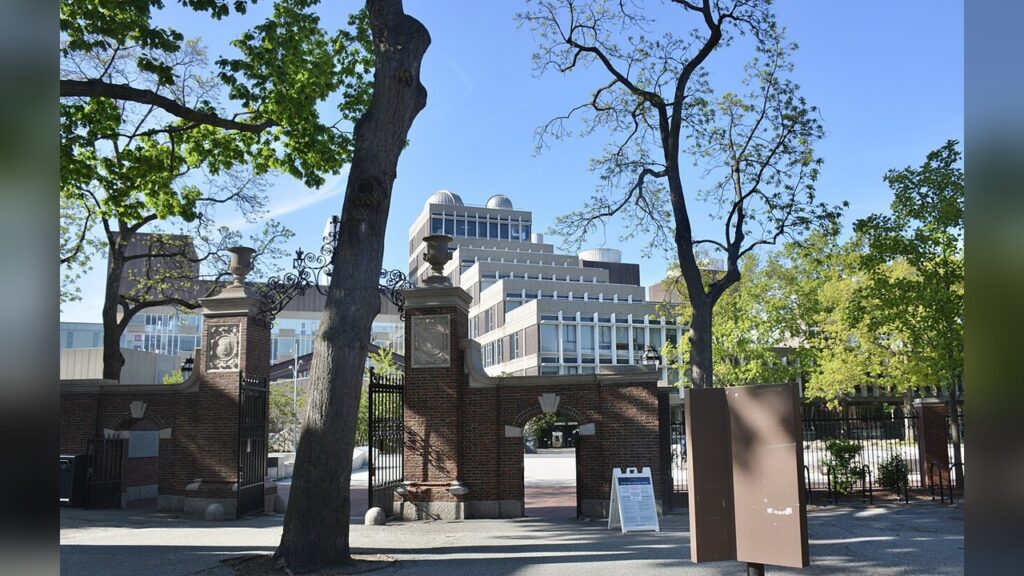 Rizka (CC BY-SA 4.0) via Wikimedia Commons
One does not need to minimize the reality of campus antisemitism, which Harvard’s own task force documented in grim detail, to recognize what was happening here. The administration was not pursuing civil rights enforcement. It was pursuing institutional subordination, using Title VI as a vehicle to extract concessions, from admissions policy to governance structure, that have nothing to do with antisemitism and everything to do with political control of universities that the president finds ideologically inconvenient. Judge Allison D. Burroughs made the same observation last September when she ruled the administration had unlawfully cut nearly $3 billion in Harvard grants, using antisemitism as what she called a “smokescreen.” Two federal judges in the same district, arriving at the same conclusion through different procedural doors, is not a coincidence. It is a pattern.
Harmeet K. Dhillon, the assistant attorney general for Civil Rights, announced that the DOJ disagrees and is “assessing next steps,” while touting the division’s “extensive and active portfolio of antisemitism enforcement.” One trusts the portfolio is more carefully assembled than this complaint was. The literature on Title VI enforcement is not obscure. The statutory standard is not ambiguous. The procedural requirements are not optional. And a federal court is not a press conference, however much this administration might wish it were.
 Brett Sayles / Pexels