



A courtroom in Damascus did something this week that would have been unthinkable two years ago. Judge Fakhareddine al-Aryan looked at the record of Bashar al-Assad’s 14-year war on his own people and said the quiet part out loud: “Bashar Assad used state agencies to commit war crimes and crimes against humanity.” Then he sentenced the former president to death.
The Fourth Criminal Court convicted Assad in absentia on Tuesday for premeditated murder, torture, arbitrary arrest, and crimes against humanity. His brother Maher, who commanded the regime’s most brutal units, got the same. Six other former officials were sentenced alongside them. The trial aired live on Syrian state television, the same airwaves Assad once used to broadcast confessions extracted under electrocution and starvation.
Half a million people are dead. Let that number sit with you. Half a million Syrians killed in a conflict that one family manufactured to keep itself in power, and the machinery of that slaughter was not a glitch. It was the state. Police, military, intelligence services, courts, all bent toward one purpose: keeping the Assads on top.
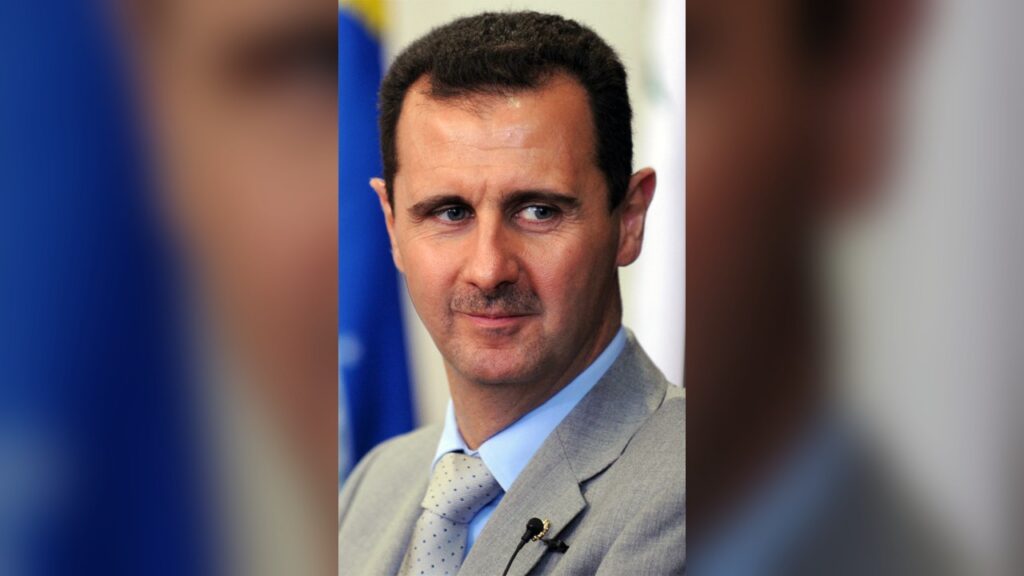 Bashar_al-Assad.jpg: Fabio Rodrigues Pozzebom / ABr derivative work: César (talk (CC BY 3.0 br) via Wikimedia Commons
One defendant was physically present to hear his sentence. Atef Najib, Assad’s maternal cousin and former head of political security in Deraa province, stood inside a cage in the courtroom as the judge read the verdict. Deraa is where the 2011 uprising began, where children were arrested and tortured for writing graffiti on walls. Najib oversaw the crackdown that turned peaceful protests into a national inferno. He is the only sentenced official currently in custody.
The rest are in Moscow. Assad, now 60, fled Damascus as rebel forces closed in during December 2024, ending his family’s five-decade grip on Syria. Vladimir Putin gave him asylum, the same way a landlord hides a tenant who burned down the building.
And here is where the verdict collides with the structure of impunity. A death sentence means nothing if the person it targets is sipping tea in a Moscow apartment while his victims’ families are still identifying remains in mass graves. Russia shielded Assad before the fall and shelters him now. There is no indication Moscow plans to hand him over. The Syrian government’s new authorities may request extradition. They will almost certainly be refused.
So what does accountability look like when a nuclear-armed patron simply says no?
 Alexey V. Kurochkin (CC BY-SA 4.0) via Wikimedia Commons
It looks like this: a verdict that matters because it establishes the record. The first formal conviction against Assad or anyone in his inner circle since the regime collapsed. A judicial finding, on the record, that these were crimes, not policy disagreements, not security measures, not the unfortunate collateral of governance. Crimes. Against humanity. Named, charged, and adjudicated by a Syrian court, on Syrian soil, in the country he destroyed.
But a verdict without enforcement is a press release with a gavel. The international community, such as it is, faces a test. Will governments that sanctioned Assad’s regime now pressure Russia to surrender him? Will the International Criminal Court pursue parallel charges? Will the states that armed, funded, and diplomatically covered Assad’s war machine face any reckoning of their own?
Atef Najib in his cage is a start. Bashar Assad in a Moscow safe house is an unfinished demand. Solidarity with the half million dead means refusing to let this sentence become symbolic. Extradite him. Try him in person. Let the families look him in the eye.