



There is a particular kind of policy error that only becomes visible in retrospect, when the architecture it compromised has already collapsed. We may be watching one in real time.
At 12:01 a.m. Saturday, the United States was set to impose 50% tariffs on $20 billion worth of Canadian imports, from hockey sticks to tongue depressors, after last-ditch negotiations collapsed Friday night. U.S. Trade Representative Jamieson Greer blamed “new demands and walk backs” by Canada. Canadian Prime Minister Mark Carney called the last-minute U.S. terms “unfair, uneconomic” and said they “called into question the reliability of any deal.” Both statements are almost certainly accurate, which is itself the problem.
But the substantive story is not the diplomatic he-said-she-said. It is the legal instrument. Trump invoked Section 338 of the Tariff Act of 1930, a provision that has sat dormant for nearly a century. Never used. Not once. Not during the trade anxieties of the 1980s, not during the NAFTA negotiations, not during any of the dozens of trade frictions that have punctuated U.S.-Canada relations since the Hoover administration. There is a reason for that dormancy, and the reason is that the 1930 Tariff Act, better known as Smoot-Hawley, is among the most thoroughly discredited pieces of economic legislation in American history. Economists have spent decades building the consensus that it contracted world trade and deepened the Great Depression. This is not obscure scholarship. It is textbook material. Undergraduate textbook material.
 Policy Exchange (CC BY 2.0) via Wikimedia Commons
And yet here we are. The Supreme Court struck down Trump’s first-term tariff regime in February, ruling he had overstepped his authority by declaring the trade deficit a national emergency. So the administration went shopping for another statute and found one that requires no investigation, no finding of fact, and has no expiration. Section 338 lets the president impose up to 50% tariffs on any country deemed to have “discriminated” against U.S. commerce, a term so elastic it could accommodate nearly any grievance. This is not trade policy. It is a legal hack, a workaround designed to preserve unilateral tariff power after the Court narrowed the first one.
The economic logic is, to use the technical term, perverse. Tariffs are paid by U.S. importers, who pass costs to consumers. The $880 billion in annual bilateral trade between the two countries, the undefended 5,525-mile border, the integrated supply chains built over decades, all of it is being subjected to a tool designed for a world of collapsing economies and beggar-thy-neighbor retaliation. With midterm elections in November and voters already furious about prices, the administration is choosing to make imported goods more expensive to score a negotiating point against a country that sends 72% of its exports south.
Trump has also repeatedly mused about annexing Canada as the 51th state, which nearly 248,000 Canadians have signed a petition to expel Ambassador Pete Hoekstra over. One begins to understand why Ottawa might question the reliability of any agreement signed with this administration. Carney’s refusal to finalize under shifting terms is not intransigence. It is a rational assessment of counterparty risk.
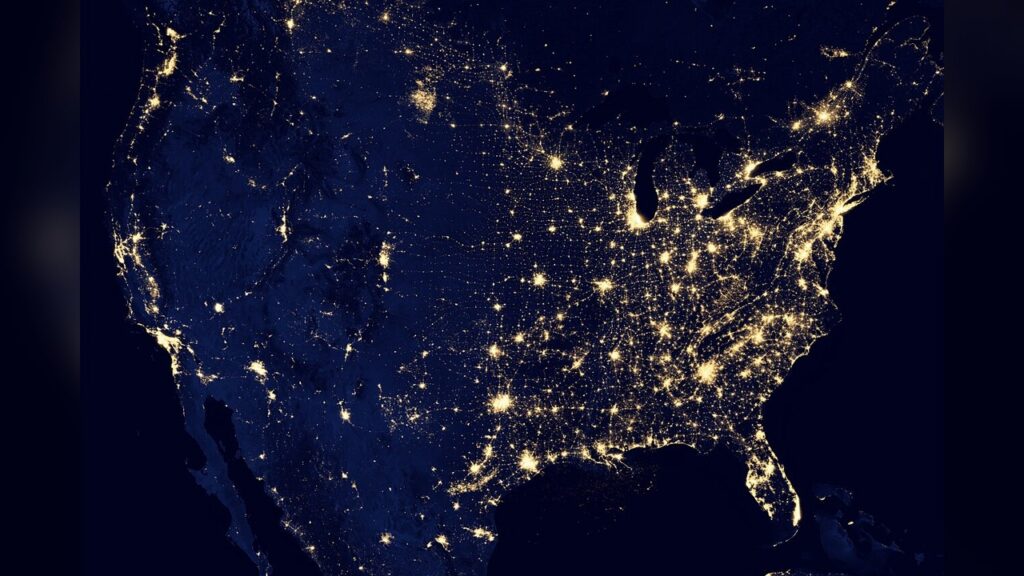 NASA Earth Observatory (Public domain) via Wikimedia Commons
The deeper structural issue is the systematic conversion of trade policy into an instrument of personal leverage, detached from economic analysis, insulated from congressional oversight, and routed through increasingly obscure statutory authorities after the obvious ones were struck down. Each workaround narrows the institutional constraints a little further. The Smoot-Hawley comparison is not a rhetorical flourish. It is the literal statutory lineage. The provision being invoked was enacted by the same Congress, in the same law, under the same assumptions about protectionism that the subsequent decade so brutally refuted.
That refutation was supposed to be settled. It was, for ninety-five years. Apparently we need to run the experiment again.