



There is a particular species of American politician that political scientists have long studied but never quite named satisfactorily: the senator who cultivates a reputation for independence through a carefully curated pattern of final-passage opposition paired with the procedural votes that actually matter. Susan Collins is, if not the type specimen, then certainly its most durable practitioner. Five terms. Thirty years. And the machinery grinds on.
Maine Democrats gathered in Lewiston on Thursday for the opening stop of what they are calling their “Retire Susan Recess” tour, and the substantive charge is straightforward enough. Collins cast a procedural vote that allowed President Trump’s “One Big Beautiful Bill” to reach the Senate floor. The legislation, as passed, cut Medicaid and rolled back Affordable Care Act tax credits. Democrats say tens of thousands of Mainers will see their health care costs rise as a direct consequence. Collins, for her part, voted against the bill on final passage. Her campaign notes she has voted against cutting Medicaid “more than a dozen times” and highlights her rural health transformation proposal, which secured $190 million in federal funding for Maine’s rural hospitals.
 United States Senate (Public domain) via Wikimedia Commons
One can admire the architecture here. The procedural vote lets the bill proceed. The final-passage vote lets the senator dissent. The dissent becomes the headline. The procedural vote becomes a footnote. And the $190 million for rural hospitals, real money that sustains real institutions, becomes the rebuttal to anyone who notices the footnote. It is not dishonesty, exactly. It is something more sophisticated than that, and more corrosive. It is the institutionalization of having it both ways until having it both ways becomes indistinguishable from having it one way.
State Rep. Drew Gattine put it bluntly in Lewiston: Collins “had the seniority and the power to stop this.” He is correct on the facts. A senator who votes to advance legislation she subsequently opposes has not opposed it in any meaningful sense. She has enabled it while reserving the right to complain. The literature on congressional procedure is unambiguous on this point. The cloture vote, the motion to proceed, the budget reconciliation instruction: these are the votes that determine outcomes. Final passage is often theater, particularly in a body where the majority leader controls the calendar.
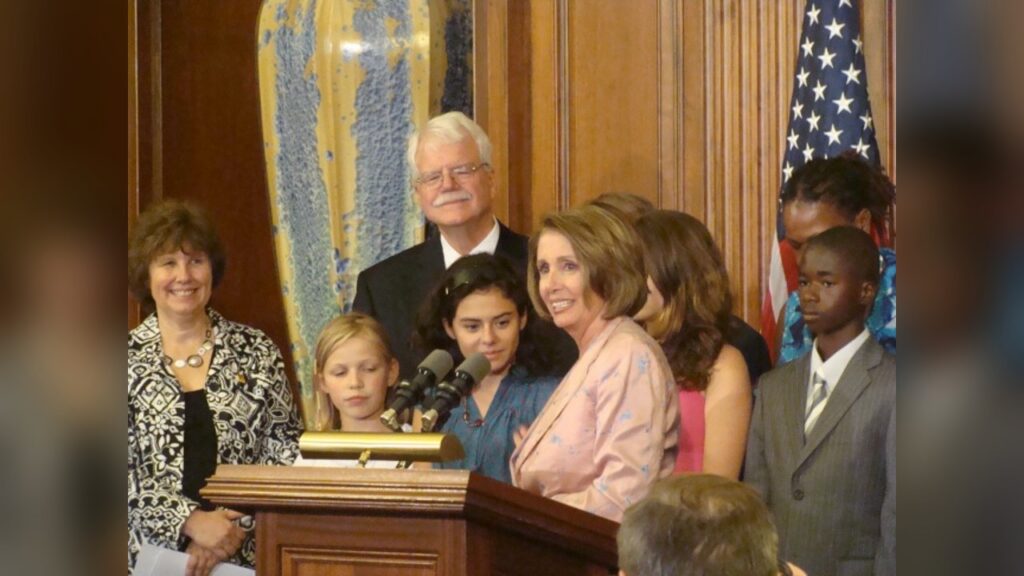 Nancy Pelosi from San Francisco, CA (CC BY 2.0) via Wikimedia Commons
Meanwhile, the ACA tax credits are expiring. Collins has sponsored no legislation to extend them. The Maine Democratic Party has been circulating letters from constituents, including a restaurant owner who describes a $40,000 hospital bill absorbed only because of the ACA’s coverage structure. Premiums, we are told, may double, triple, or quadruple. Collins’s office has produced no bill, no co-sponsorship, no amicus brief. The seniority that was supposed to be her great asset, the argument that re-elected her in 2020, has produced exactly nothing on the question that now threatens to price her constituents out of insurance markets entirely.
Enter Troy Jackson, the Democratic nominee, a former logger and state Senate president who supports Medicare for All and was chosen at a hastily convened convention in Bangor after the previous nominee withdrew following sexual assault allegations. Collins has dismissed him as a “Bernie Bro” whose positions are “clearly in line with socialism.” She has raised more than $16 million. Jackson has raised roughly $1 million since entering the race. He has less than four months.
 Uiliam Nörnberg / Pexels
The structural conditions favor Collins. Incumbency, money, name recognition, the inertia of five terms. But the structural conditions also favor the argument against her. A senator who votes to advance legislation that harms her constituents, then votes against it when the outcome is already determined, then points to an award she received for that opposition, is not a moderate. She is a mechanism. And mechanisms, eventually, get replaced.