



There is a particular species of American centrist mythology that insists Susan Collins is a check on her party’s worst impulses. The data have never supported this. What the data support is a far more durable pattern: Collins provides the minimum quantum of dissent necessary to maintain her brand, then votes with her caucus on every outcome that actually matters. The Kavanaugh confirmation was not an aberration. It was the model.
Now we have the RFK Jr. confirmation, and the consequences are arriving in Maine with the specificity of a line-item budget. Kennedy has slashed cancer research funding, gutted the health agencies that keep Americans safe, eliminated Maine jobs, and canceled $91 million in funding for Maine public health programs. Collins voted to put him there. She has offered zero regrets. And when the Washington Post recently checked in with the Democratic voters who have historically crossed party lines to reelect her, the verdict was blunt. “When she voted for RFK Jr., I totally lost it,” one former Collins voter told the paper.
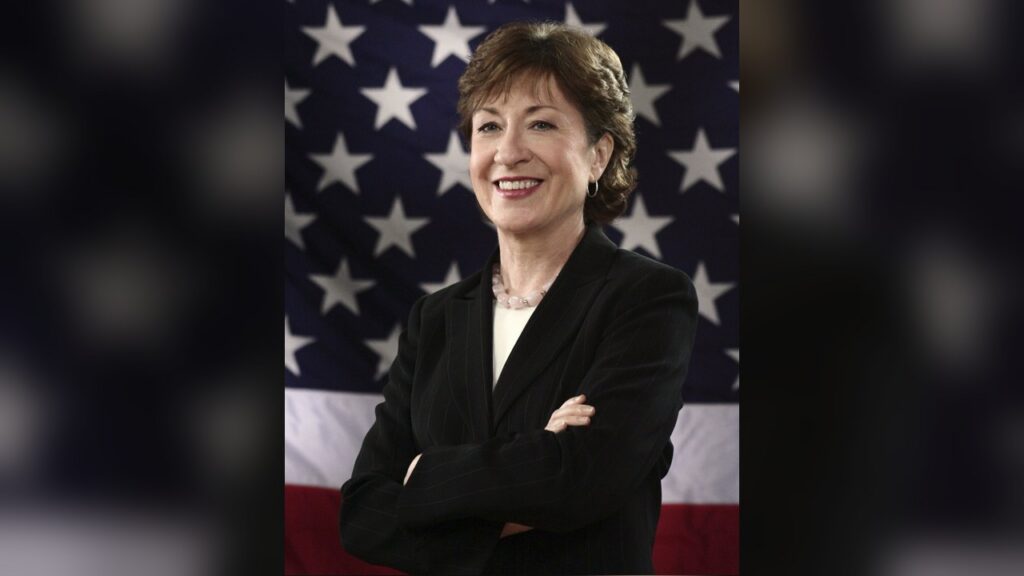 United States Senate (Public domain) via Wikimedia Commons
One understands the frustration. But one also wishes to note that the frustration is approximately four years late.
Collins has been running this play for decades. She voted to confirm Brett Kavanaugh, who then joined the majority in Dobbs v. Jackson Women’s Health Organization, overturning Roe v. Wade. She expressed concern. She voted against Amy Coney Barrett, which changed exactly nothing about the Court’s composition since Barrett was confirmed anyway. She voted to confirm Ketanji Brown Jackson, which cost her nothing because Jackson was confirmed without needing her vote. The pattern is not subtle. When her vote is dispositive, she falls in line. When her vote is decorative, she takes the principled stand.
 Democratizemedia (CC0) via Wikimedia Commons
The RFK Jr. vote fits the template precisely. Kennedy’s anti-vaccine advocacy was not a hidden dossier. It was the entirety of his public persona for two decades. Collins confirmed him anyway, and now she issues statements about being “alarmed” that he fired CDC Director Susan Monarez after three weeks on the job. She told the Maine Morning Star that Kennedy’s ouster of the entire 17-person FDA vaccine advisory committee “is likely to weaken the independent and professional recommendations of the committee.” Then, in the same breath, she added that Kennedy “has some valid points about ultra-processed foods.”
This is the Collins rhetorical signature: acknowledge the damage, praise the arsonist’s taste in wallpaper. The Maine Democratic Party’s spokesperson, Tommy Garcia, called it correctly. “Any false outrage or ‘concerns’ from Collins will fall flat with Maine voters.” The statement is not merely partisan spin. It is an accurate description of a senator who confirms an anti-science ideologue to run the nation’s health apparatus, watches him dismantle $91 million in funding for her own state’s public health infrastructure, and then produces the facial expression of mild disappointment she has been rehearsing since the Clinton impeachment.
 Gordon Leggett (CC BY-SA 4.0) via Wikimedia Commons
What is changing now is not Collins. Collins is a fixed variable in this equation. What is changing is the tolerance of the voters who have been solving for her. The Washington Post piece suggests the Democratic crossover coalition that has sustained her through six terms is finally computing the cost. The $91 million in canceled Maine public health funding is not an abstraction. It is a number with a constituency.
The structural irony is that Collins may be the last Republican in New England precisely because she mastered the art of looking uncomfortable while voting for catastrophic outcomes. The question is whether Maine’s voters have finally stopped confusing discomfort with dissent.