


Funny how the legal system works when the dead guy is somebody the establishment wouldn’t mind seeing gone.
Charlie Kirk, conservative activist, was shot dead from a rooftop on September 10 at Utah Valley University while addressing a crowd of thousands. The man charged with his killing, Tyler Robinson, turned himself in the next day. DNA tied him to the rifle. He apparently confessed. And now his lawyers are in court arguing that their client should not face the death penalty because, and I want you to really sit with this, the shooter “hit the intended target.”
That is their actual argument. Filed in real court documents. By licensed attorneys. The bullet traveled above the crowd, not through it, so nobody else was endangered, so it is not a capital crime. He only killed one person on purpose. That is the pitch.
Ask yourself who benefits from a legal standard where a sniper who picks off a political speaker gets credit for not spraying the audience. Because that is what this is. The defense is asking a judge to reward precision. You lined up a rifle on a rooftop and killed a man in front of thousands, but you did it efficiently, so maybe we go easy on you. That is the system treating a political assassination like a golf shot. Good form, clean kill, no collateral damage, let us talk about mitigating circumstances.
Prosecutors say Robinson loaded four rounds. The defense counters that “it is just as likely that the shooter did not believe he would miss.” So now we are psychoanalyzing a rooftop assassin’s self-confidence. He believed in himself, your honor. He had faith in his aim. That is the defense. I have heard some creative lawyering in my time, but “my client was too sure of himself to be a danger to others” is a new one.
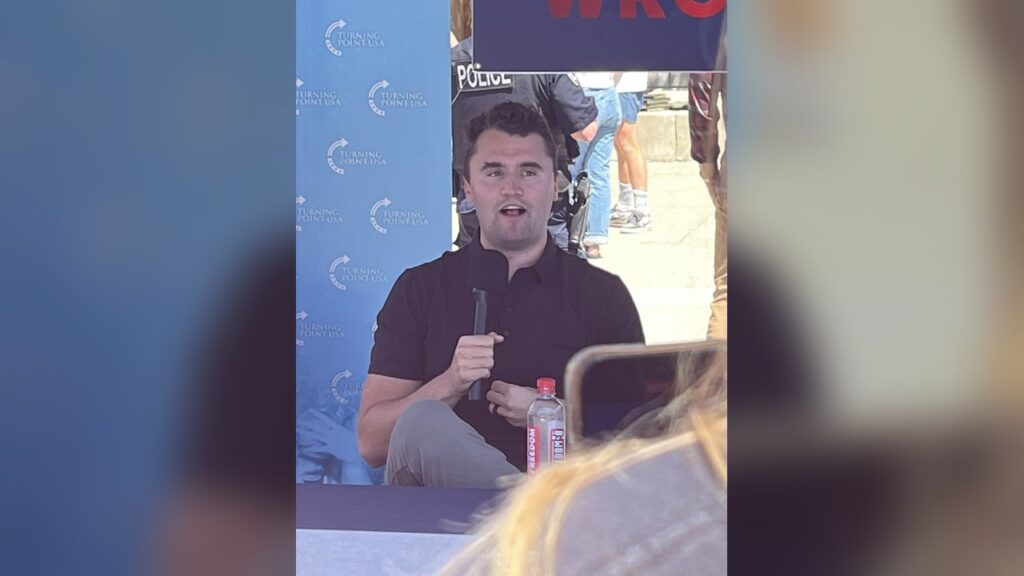 Shoot for the Stars (CC BY-SA 4.0) via Wikimedia Commons
Then there is the motive question. Prosecutors say Robinson told his roommate he killed Kirk because he “had enough of his hatred.” Kirk was a vocal opponent of same-sex marriage and gender transitioning. Robinson was in a relationship with his roommate, Lance Twiggs, who told investigators he had been considering transitioning around the time of the killing. The defense says that one statement is not enough to prove motive, because searches of Robinson’s apartment, computer, and phone turned up nothing else. No manifesto, no social media trail, no angry posts about Kirk.
Here is where I put on my dot-connector hat. The roommate says Robinson sometimes talked politics, including about Trump, but never mentioned Kirk. Never talked much about gender issues or LGBTQ+ rights either. So this guy never talked about Kirk, never talked about the issues Kirk was known for, but climbed a roof with a loaded rifle, killed him, then told his roommate it was because he “had enough of his hatred.” And the defense wants you to believe the political angle is thin.
Maybe it is thin. Maybe it is not. But I notice which direction the skepticism always runs. When the victim is a conservative, the system bends over backward to find reasons the killing was not really that bad. The prosecutors were already caught in contempt of court for running their mouths to the media, and the defense tried to use that to get the death penalty thrown out. Judge Tony Graf said no. Good for him. But the fact that the defense even tried tells you everything about how comfortable they are treating this like a routine case with room to negotiate.
Kirk’s family has asked Graf to make his ruling on September 1 so the case can move forward. Closing arguments are set for that day. The preliminary hearing has dragged on far longer than usual, which the experts attribute to caution and the volume of evidence. Caution. Always caution. Funny how caution always seems to slow things down when the dead man is somebody the smart people in the room quietly think had it coming.
The shooter hit his target. That is not a defense. That is a confession with better lawyers.