



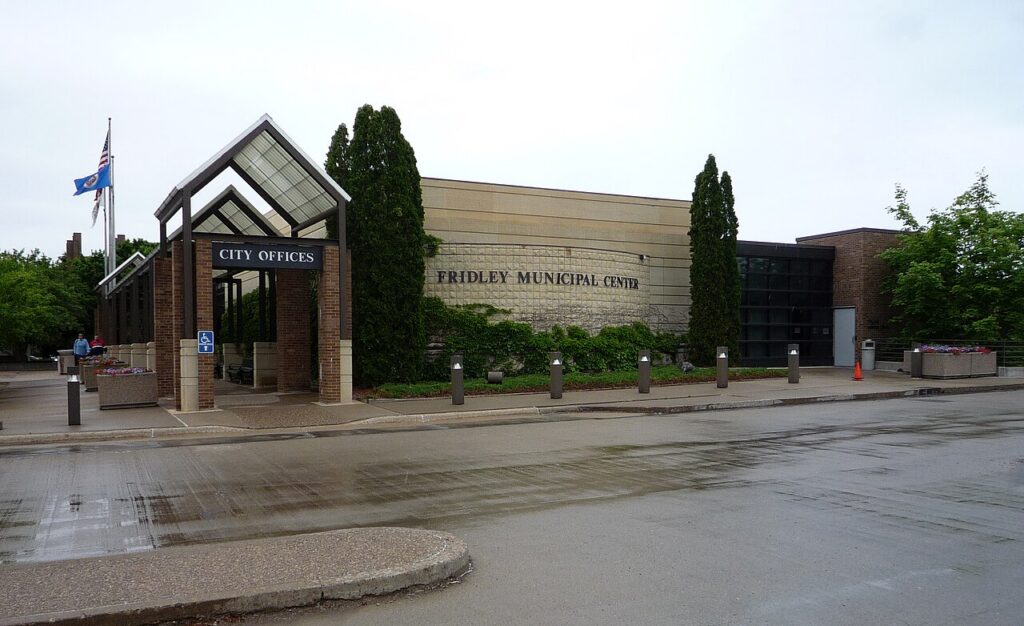
Here’s what happened in Fridley, Minnesota, and you should pay attention because it’s coming to your town next.
Residents packed a city council meeting on July 27. They weren’t there to talk about potholes. They were there because they’d found out that little cameras bolted to poles all over their city, cameras most of them probably never thought twice about, were feeding license plate data to law enforcement agencies across the country. And some of that footage had been used for immigration-related searches. A company called Flock Safety, valued at $7.5 billion and backed by Andreessen Horowitz, had quietly turned their streets into a dragnet. Nobody asked them. Nobody voted on it in any way that meant something.
A resident named Daniel Hartman stood up and said what a lot of people in that room were thinking. He talked about building a life, raising a family, not living in fear of one another. He asked the council to disarm the cameras. Simple as that.
 Q12307142 Q12315752 (Public domain) via Wikimedia Commons
Now, the council didn’t disarm them. But ten days later, Fridley restricted out-of-state access to the Flock data. So something got through. The people showed up, and something budged. That matters.
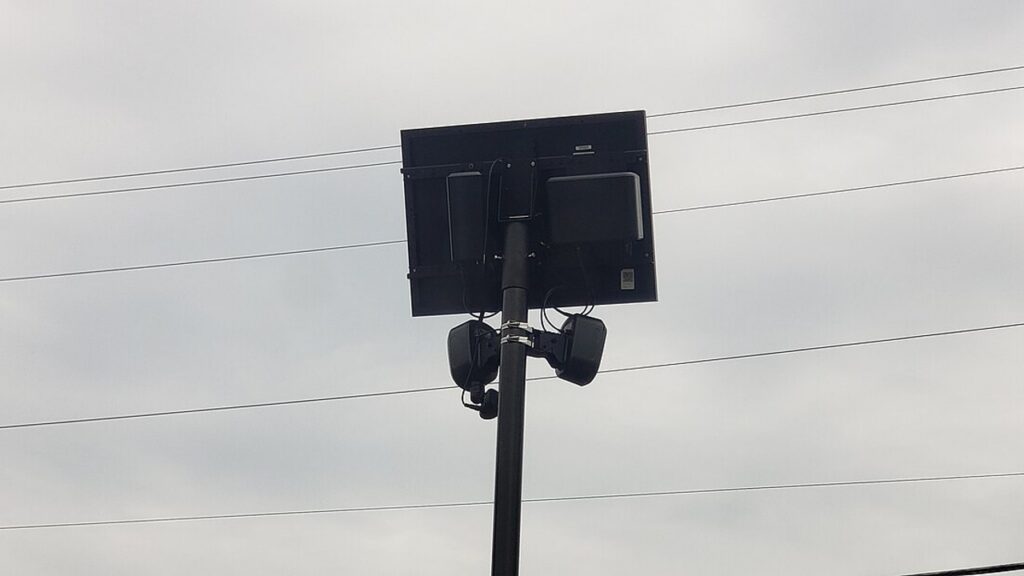
Here’s the part that should make your blood boil. Flock Safety has more than 12,000 clients. Over 5,000 law enforcement agencies. The group DeFlock has mapped more than 99,000 of these cameras across the United States. Ninety-nine thousand. They read your license plate, log your location, note your bumper stickers and roof rack, and store all of it in a database that local cops can share with federal agencies. Flock says they don’t have a contract with ICE. They also admit that local and state police can hand the data over to federal authorities whenever they want. So which is it? Because those two statements don’t live in the same house.
And it gets worse. In Dunwoody, Georgia, a resident named Jason Hunyar filed more than 100 FOIA requests and discovered that Flock had been using camera data from a playground, a school, a Jewish center, and a children’s activity space to run product demonstrations for outside agencies. Your kids’ playground was a sales floor. The Dunwoody City Council still unanimously approved a new Flock agreement. They just added a clause saying Flock can’t use their town’s data for demos anymore. Problem solved, right? Except the cameras are still there. The data is still flowing. They just moved the showroom.
 Bobak Ha'Eri (CC BY 3.0) via Wikimedia Commons
Between August 2021 and May 2026, 82 Flock contracts were terminated in 28 states. Thirty-nine of those came between January and May of this year alone. Sixty-eight cities have specifically rejected the technology. Washington state passed a law limiting Flock data to felony investigations and requiring deletion within three weeks. A proposed federal bill, sponsored by a progressive Democrat and a hard-right Republican, would withhold highway funding from any state that allows these cameras except for tolling. When a progressive Democrat and a hard-right Republican agree on something, that’s not a partisan issue. That’s a gut instinct. That’s Americans looking at a pole-mounted camera and understanding in their bones that this is not freedom.
Will Freeman, who runs DeFlock, says there’s no independent evidence that these cameras prevent or solve meaningful amounts of crime. Robert Frommer, a senior attorney at the Institute for Justice, calls Flock the “poster boy” for surveillance worries. He said Americans are starting to realize there’s been an entire surveillance industry erected around them. He’s right. And the industry didn’t ask permission. It slid in through procurement contracts and piggyback deals and sheriff’s office operating budgets that never needed a vote.
In Minnesota, somebody is taking matters into their own hands. Eight Flock cameras vandalized in Winona. Six in Edina. I’m not telling you to do that. I’m telling you that’s what happens when people feel like nobody listened the first hundred times they complained through the proper channels.
 Epicdeflocker64 (CC0) via Wikimedia Commons
Fridley is a small city. It’s not Chicago. It’s not Los Angeles. If the people of Fridley can pack a council meeting and force a $7.5 billion company to retreat even one step, so can you. Find out if there’s a Flock camera on your street. Go to the next council meeting. Ask who has access to the data. Ask how long it’s stored. Ask whether it’s been shared with federal immigration authorities. Ask whether your kid’s school playground is a product demo.
They’re counting on you not to ask. Prove them wrong.
Watch: https://www.youtube.com/watch?v=VdnmPEOiHJc