



Samuel Alito has a message for anyone who thought the Supreme Court’s right-wing supermajority might loosen its grip: stop hoping.
“Obviously, I’m here for another term,” the 76-year-old justice told The Wall Street Journal’s editorial page, settling into his chambers for a rare interview that functioned less as a judicial reflection than as a victory lap. The retirement speculation that swept Washington in June, triggered by an NPR reporter’s erroneous publication of a pre-written retirement story, is dead. Alito killed it himself, on his own terms, in the friendly confines of the Journal’s opinion section.
Let us be clear about what this means. The man who wrote the opinion dismantling Roe v. Wade, who has been the muscular force behind a 6-3 conservative supermajority that has pushed the nation sharply rightward on abortion, immigration, race, and voting rights, is not going anywhere. He is at the apex of his power. He knows it. And he wants you to know it too.
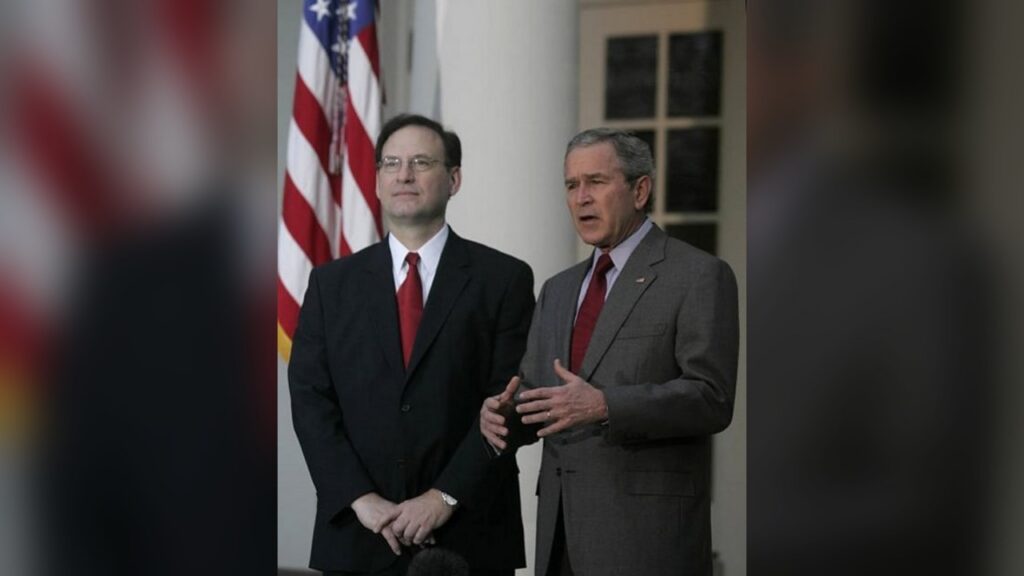 White House photo by Kimberlee Hewitt (Public domain) via Wikimedia Commons
Alito also used the interview to reject the idea that partisanship drives his decisions. “I vote in every case the way I think the case should be decided,” he said. “If that means a high correlation with what Trump wants, fine.” Fine. He said fine. A Supreme Court justice acknowledging that his rulings track neatly with the policy preferences of the president who shares his ideology, and his response is a shrug. This is the judicial neutrality that Chief Justice John Roberts keeps insisting the public should respect. A justice who openly admits his decisions correlate with Trump’s agenda and calls it beside the point.
Donald Trump, for his part, could barely contain his delight. He called Alito “one of the great justices of all time” and “a brilliant justice” who “gets the country.” He told Fox Business he is “prepared” to nominate a fourth justice if an opening arises. He even pointed to Ruth Bader Ginsburg as a cautionary tale, describing her death in 2020 with the warmth of a man recounting a successful real estate transaction. “She decided that she was going to live forever, and about two minutes after the election, she went out and I got to appoint somebody.” That is a president talking about a trailblazing jurist the way a landlord talks about a tenant who finally cleared out.
Senate Majority Leader John Thune has already signaled that Republicans would rush to confirm any vacancy before the midterms. Trump reportedly has Ted Cruz on his shortlist. The machinery is greased and waiting.
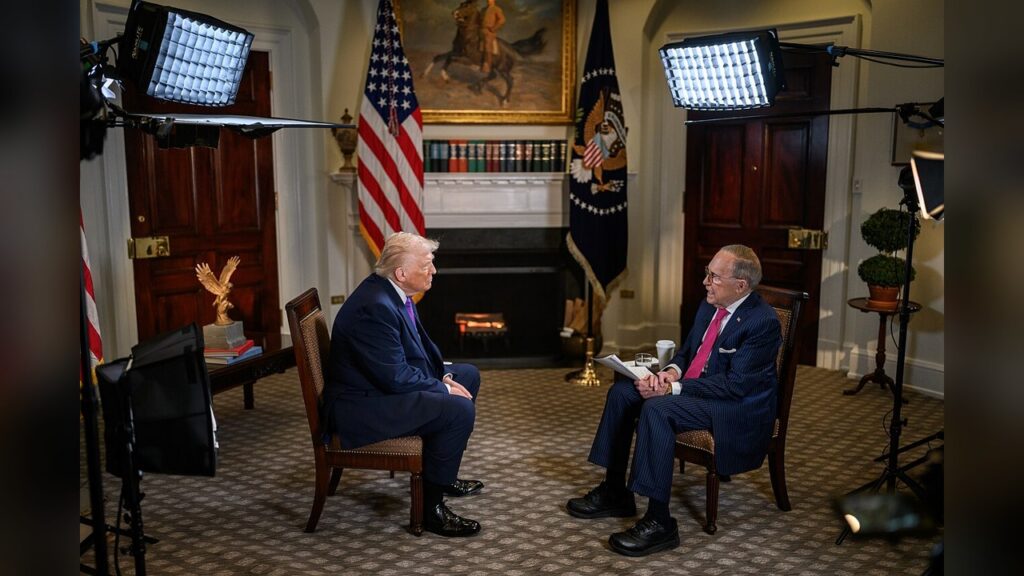 The White House (Public domain) via Wikimedia Commons
Here is the structural truth that no amount of Roberts’s speeches about institutional legitimacy can obscure. Supreme Court justices alone decide not only how long they serve but when a like-minded successor has the best chance of inheriting their seat. No justice since Thurgood Marshall in 1991 has voluntarily stepped down knowing a president from the opposing party would choose the replacement. Every retirement has become an exercise in ideological succession planning. The seat, not the justice, is the prize. And Alito is not ready to hand his to anyone who does not share his vision.
This is not a court of law standing outside politics. It is a court that has been captured by an unelected supermajority, wielded by justices who behave like movement stewards while demanding the public call them neutral umpires. Alito staying another term means more rulings that erode voting rights, strip regulatory protections, and reshape constitutional law for a generation.
The answer is not to wait for the next retirement announcement. The answer is structural: term limits, court expansion, binding ethics rules. A judiciary where one 76-year-old’s personal calendar determines the constitutional rights of 330 million people is not a democracy. It is a throne room. And Alito just made clear he is not abdicating.