


A 22-Foot Boat, Fourteen Souls, and the Regulatory Vacuum That Drowned Them
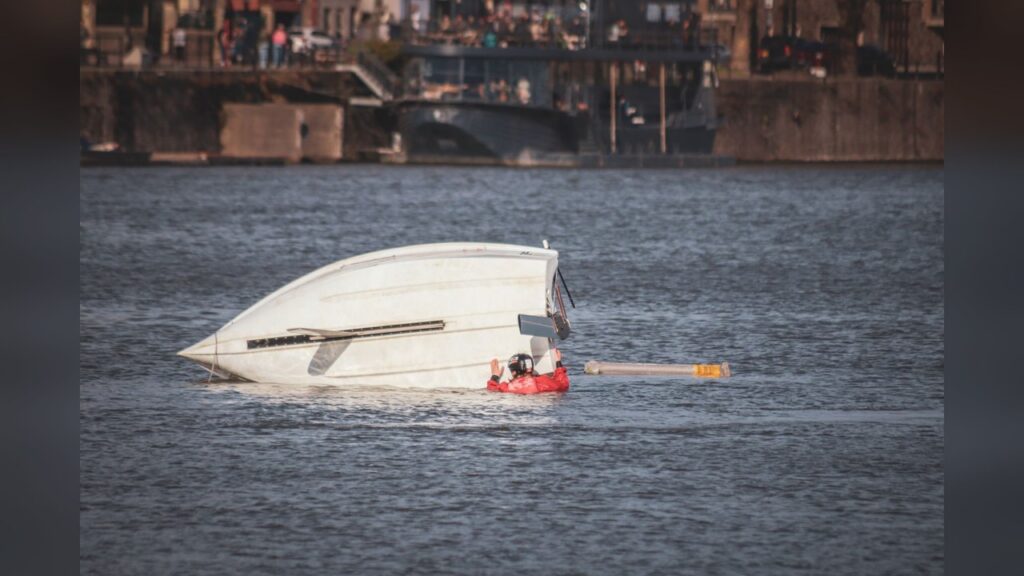
There is a particular kind of American tragedy that requires not one failure but an entire architecture of non-enforcement to complete itself, and what happened in New York Harbor on Saturday night is a textbook specimen. Fourteen people climbed aboard a recreational powerboat, a vessel whose rated capacity sits around ten and whose safe passenger load in that location, according to a well-placed source who spoke to the New York Post, should not have exceeded five. A 5-month-old infant named Antonella Garcia and her mother, Sara Sanchez, 27, of College Point, Queens, are now dead. The boat’s operator, Manuel Hernandez, 46, resident of a rather comfortable Midtown Manhattan building just south of Central Park, was arrested at 2:30 a.m. Sunday and charged with 13 counts of reckless endangerment. Further charges are expected. The U.S. Coast Guard is investigating whether the vessel was part of an illegal charter operation.
I want to be precise about what that last sentence means, because it is doing a great deal of work. An illegal charter operation is not a rogue phenomenon. It is a market response to a regulatory vacuum. When a harbor as congested, as commercially active, and as physically treacherous as New York’s operates what one source accurately called “the Wild West” of recreational boating, with uncharted debris and bridge abutments and anchorage chains and commercial shipping channels and marine plane traffic all sharing the same water, the absence of meaningful inspection and enforcement is not an oversight. It is a policy choice. And policy choices have body counts.
The National Weather Service recorded clear skies and light westerly winds around 10 mph that evening. This was not a storm. This was not an act of God. This was a 2019 Yamaha AR210, a boat designed for leisurely afternoon cruising, loaded with 14 human beings in one of the most navigationally complex waterways in the Western Hemisphere, at 10:25 at night, near Buoy 32 between the Statue of Liberty and the Bay Ridge Anchorage. Twelve people were pulled from the water before police even arrived, which tells you that the disaster was total and immediate, not gradual. NYPD divers found Sanchez and her infant in the water. Both were transported to NYU Langone Hospital in Brooklyn in critical condition and pronounced dead. The baby’s father was on the boat. He survived.
 Flint Huynh / Pexels
Hernandez will be prosecuted, and he should be. Thirteen counts of reckless endangerment is a start, and the additional charges involving the deaths will presumably follow. But the literature on regulatory failure is quite clear on this point: prosecuting the individual operator after the catastrophe is the least effective possible intervention, because it does nothing to alter the structural conditions that made the catastrophe inevitable. The Coast Guard’s investigation into whether this was an illegal charter is the more consequential inquiry, but one is compelled to ask why that question is being posed only after a mother and her infant are dead. The enforcement mechanism, if it exists at all, appears to operate exclusively in retrospect.
Twelve survivors were rescued by bystanders and other vessels before first responders reached the scene. That is a testament to ordinary human decency and also an indictment of the assumption that decency will substitute for regulation. It will not. It never has. The water does not care about good intentions, and the market for unregulated charter boats does not self-correct. It finds customers who do not know what they do not know, puts them on vessels that should not be where they are, and waits.
The harbor is not the Wild West. The Wild West, at minimum, had the decency to be honest about what it was. This is something worse: a regulatory system that knows the danger, has the authority to act, and waits for the next body before it bothers.