



Trump’s Vaccine Order Demands Shots That Haven’t Existed in 50 Years
There is a particular kind of policy failure that only becomes visible when you trace its full supply chain. President Trump’s executive order, signed Monday, instructing federal officials to break the measles-mumps-rubella vaccine into three separate injections and reduce recommended childhood immunizations from 18 to 11, is a textbook case. It is, simultaneously, a public health catastrophe in its signaling and a logistical impossibility in its execution. That it is both at once is what makes it worth examining with some care.
 Shealeah Craighead (Public domain) via Wikimedia Commons
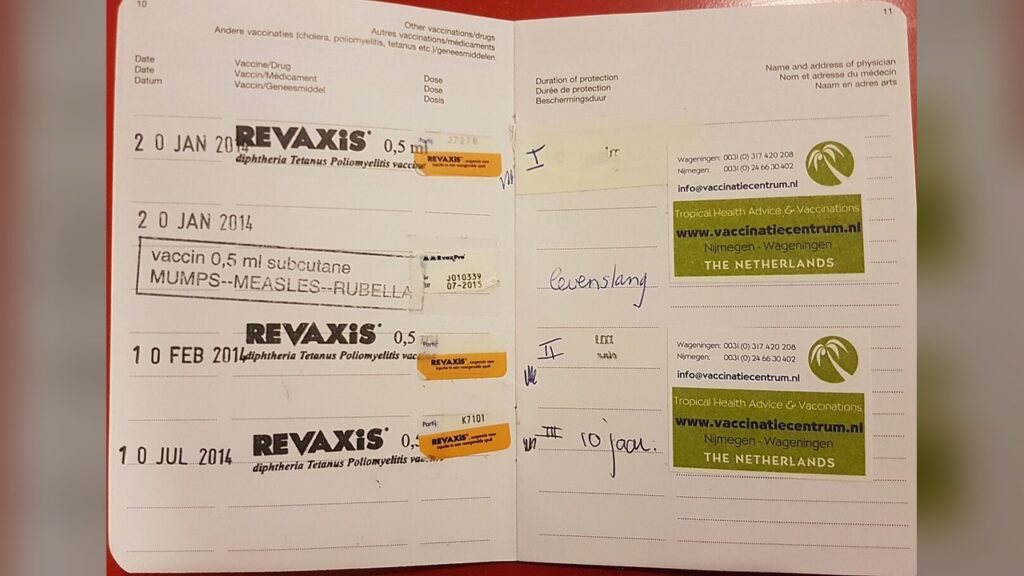
Consider the manufacturing question, which is where the order collides most spectacularly with material reality. There are currently no standalone measles, mumps, or rubella vaccines approved for use in the United States. There haven’t been for roughly half a century. The three-in-one MMR shot has been the American standard since the early 1970s, and the companies that make it, Merck and GSK, have no reason on earth to unbundle a product they already sell profitably as a combination. As Dr. Paul Offit of the Children’s Hospital of Philadelphia put it with admirable directness, they would be competing against themselves. Designing, constructing, and securing FDA licensure for new manufacturing facilities typically takes about five years. The order demands plans within 90 days. One does not need a degree in operations research to detect the mismatch.
Then there is the evidentiary question, by which I mean the complete absence of one. The president announced that “decades ago, children received only a small fraction of the vaccines required today” and that “in those times, people were much healthier and of course the high rates of autism now observed did not exist.” The 2019 Danish cohort study of 657,461 children found no association between the MMR vaccine and autism. The CDC, the AAP, and every relevant professional body have said the same. When a reporter asked Trump for evidence that the MMR vaccine could be “quite lethal,” as he claimed, he answered, “What I’ve heard is that there are some people that say it is that way.” I have graded undergraduate papers with more rigorous citation practices.
 U.S. Department of Health and Human Services (Public domain) via Wikimedia Commons
What we are watching is not merely ignorance applied to policy. It is the systematic relocation of authority away from the institutions that have spent decades accumulating the relevant expertise. Health Secretary Robert F. Kennedy Jr., who insisted in a CNN interview that he has “never questioned the efficacy of the MMR vaccine,” a claim that is rather generously contradicted by his own public record, is now the person charged with implementing this vision. Senator Bill Cassidy, the Republican physician who cast the deciding vote to confirm Kennedy and who admonished the order as “wrong,” noted correctly that “the President does not have the expertise to make these changes.” He does not. But the deeper problem is that the order does not require him to.
The order is guidance, not mandate. States control school vaccination requirements. Drugmakers cannot be compelled to produce vaccines they have no interest in making. The likely outcome, as several experts noted, is that states ignore it and companies decline to participate. But the damage is not in the implementation. It is in the permission. When a president tells parents that the standard childhood vaccine schedule is suspect, that aluminum adjuvants warrant alternatives, that combination shots may be “quite lethal,” he is not legislating. He is normalizing a framework in which the accumulated consensus of virology, epidemiology, and pediatric medicine is treated as one opinion among many, and not a particularly fashionable one.
 Nederlandse Leeuw (CC BY-SA 4.0) via Wikimedia Commons
Dr. Jesse Goodman, the former FDA vaccine chief now at Georgetown, said he could not think of “any comparable example of removing hugely effective public health measures that protect babies for no documented scientific reason.” That is because there isn’t one. And the fact that the order will probably fail in practice does not mean it is failing in purpose. It is working exactly as intended. It is telling millions of parents that the experts are wrong and that a man who compares a 0.5-milliliter injection to pouring soda into a child’s body knows better. That is the policy. The rest is logistics.