


There is a tendency, when discussing the Trump administration’s executive orders against major law firms, to treat each new directive as an isolated act of pique. This is, to put it generously, an analytical failure. What we are observing is not a series of grudges but a system, and systems deserve to be read as systems.
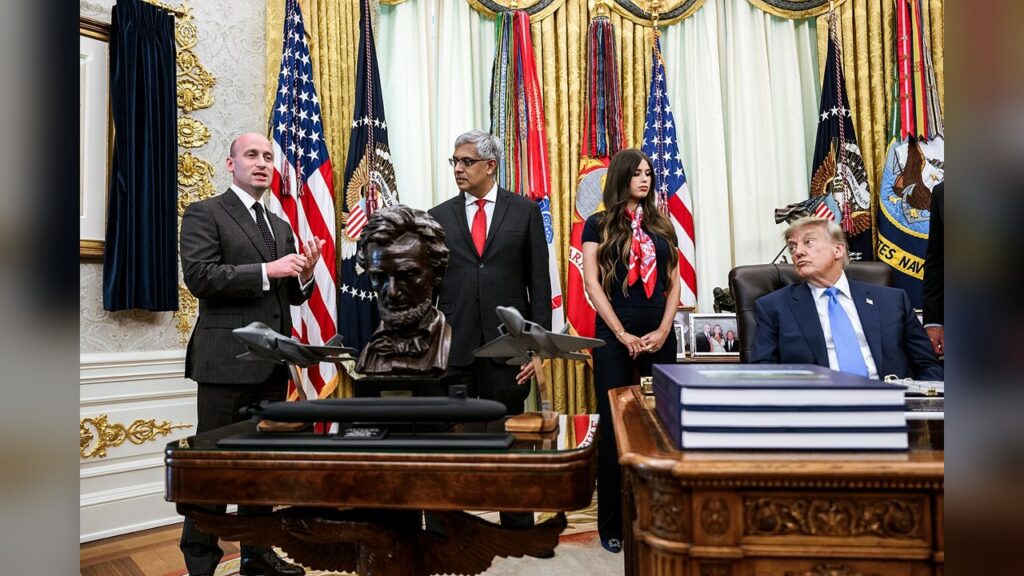
On Tuesday, President Trump signed an executive order targeting Jenner & Block, mandating the cancellation of its federal contracts and the revocation of its security clearances. The stated rationale is the firm’s past employment of Andrew Weissmann, who served as a lead prosecutor on Special Counsel Robert Mueller’s team. “He’s a bad guy,” the president said of Weissmann moments before signing. The order itself describes Weissmann’s career as “rooted in weaponized government and abuse of power,” a phrase that does considerable rhetorical work while performing very little analytical labor.
What is actually happening here is not difficult to understand, though one apparently needs a doctorate to say it slowly enough for the audience that needs to hear it. The president is identifying attorneys who participated in investigations of him, locating the firms that currently or formerly employed them, and then using the instruments of the executive branch to punish those firms. The firms are given a choice: resist and face the crippling loss of security clearances and federal contracts, or capitulate and purchase clemency through pro bono commitments to the administration’s agenda.
Paul, Weiss chose the latter. Last week, Trump announced that the firm had agreed to his demands, including $40 million in pro bono work for his administration. One might call this a shakedown. One would be correct. Perkins Coie, targeted over its work for Hillary Clinton’s 2016 campaign and its connection to the Fusion GPS dossier, has chosen to fight in court. Jenner & Block said Tuesday it will “pursue all appropriate remedies.” Covington & Burling was hit with a narrower order for representing Jack Smith. The pattern is not subtle. It does not need to be.
Richard Primus, a constitutional law professor at the University of Michigan and a former Jenner & Block attorney, described the orders accurately: “They are a revenge program, in part.” But Primus identified the deeper structural issue when he noted that the president “doesn’t recognize the category of legitimate opposition. If you are opposed to me, your actions are illegitimate, and you should be shunned, punished and criminalized.” This is the observation that matters. The legal profession operates on a premise that representation is not endorsement, that every defendant deserves counsel, and that adversarial process is the mechanism by which truth is approximated. The Trump orders reject that premise root and branch. To represent a client adverse to the president is to become an enemy of the president. The firm becomes the target. The attorney becomes the evidence.
 RDNE Stock project / Pexels
Twenty Democratic attorneys general have denounced the campaign as a “clear threat to our system of justice.” The White House, through spokesperson Harrison Fields, has framed it as “Making Big Law Great Again,” which is the kind of formulation that tells you everything about how seriously this administration takes the independence of the bar. Not at all, to be precise.
The order against Jenner & Block also criticizes the firm’s legal work supporting protections for transgender people and immigrants, accusing it of pursuing “partisan goals.” One notes that civil rights litigation has historically been characterized by its opponents as partisan, a rhetorical move with a long and discreditable pedigree. The literature on this is extensive. I will not summarize it here, as the audience for this column presumably has access to a library.
What we are watching is the deliberate conversion of the legal profession into an instrument of presidential loyalty. Firms that comply are rewarded with contracts and access. Firms that resist are stripped of both. The mechanism is elegant in its simplicity and devastating in its implications. The bar has spent centuries establishing the principle that no sovereign should dictate who lawyers may represent. That principle is now being tested, and the test is not hypothetical.
The question is not whether Andrew Weissmann is a “bad guy.” The question is whether the president of the United States should possess the authority to bankrupt a law firm for having employed someone who once investigated him. The answer, for anyone who has read anything written between roughly 1215 and last Tuesday, is no.