


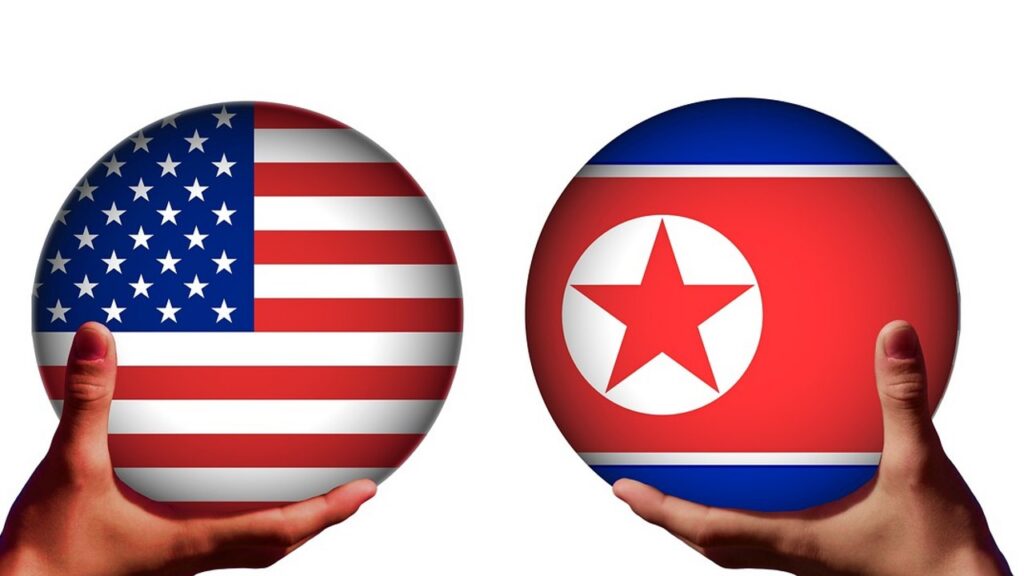
There is a well-established body of literature in international relations theory on what scholars call “personalism in foreign policy,” the tendency of leaders to substitute affective bonds for institutional process. The literature is not kind to the practice. And yet here we are again.
President Donald Trump announced Wednesday, while walking reporters around the White House grounds to show off his new helipad, that he intends to meet with Kim Jong Un later this year. This would be the fourth summit between the two men. The first three produced no verifiable denuclearization, no binding framework, and no reduction in North Korea’s warhead inventory. What they did produce was a historic photo op at the Demilitarized Zone and, apparently, roughly eight hours of cumulative face time that the president of the United States now cites as the primary structural barrier between Kim Jong Un and nuclear aggression.
Eight hours. To put that in perspective, the Vienna summit of 1961, where Kennedy and Khrushchev spent roughly two days in direct contact, is generally regarded by historians as a near-disaster that accelerated the Berlin Crisis. And those were two leaders operating within coherent institutional frameworks. Trump is proposing to manage a 57-warhead nuclear state through what he describes, with characteristic precision, as a matter of getting along.
“I know Kim Jong Un very well,” the president said, “and he’s going to be fine as long as we have a smart president.” The epistemological claim here, that eight hours of summitry constitutes knowing someone very well, would not survive a first-year seminar in qualitative methods. But the more troubling structural point is what Trump has done to reinforce this relationship: he cut short joint military exercises with South Korea, exercises that Pyongyang has long condemned as provocative. Neither U.S. nor South Korean military officials were apparently advised before the order. He described the drills as “hostile” toward North Korea, a framing that adopts, with striking fidelity, the rhetorical position of the Korean People’s Army.
 Sean P. Twomey / Pexels
Kim Yo Jong, the leader’s sister and a senior figure in the Workers’ Party, offered a useful corrective to any optimism. In comments to North Korean state media reported by the Wall Street Journal, she acknowledged that her brother “personally holds good memories and feelings toward Trump” but added that “the U.S.’s hostile policy remains unchanged.” One might translate that from the diplomatic register as follows: the feelings are reciprocated, the policy is not. The North Korean position, in other words, is that personal warmth is a welcome atmospheric but not a substitute for concessions, which is a more sophisticated understanding of summitry than the American president appears to possess.
Trump, for his part, shrugged off the arsenal he accurately pegged at 57 weapons, blaming previous administrations for its existence. “If I were president, I wouldn’t have allowed it,” he said, a counterfactual that is as unfalsifiable as it is useless. The Federation of American Scientists and the Stockholm International Peace Research Institute have tracked North Korea’s warhead growth across administrations of both parties. The trajectory is structural, rooted in the regime’s existential reliance on nuclear deterrence, not in the personal failings of whichever American happened to occupy the Oval Office. No president “allowed” it in the sense Trump implies. The weapons were built because the Kim regime calculated, correctly, that a nuclear arsenal was the only guarantee against the fate of Muammar Gaddafi, who surrendered his program and was later deposed with Western assistance. That is the literature. It is not complicated.
What is complicated, and what the president’s instinct toward personalist diplomacy cannot accommodate, is that North Korea’s nuclear program is a rational response to the regime’s structural insecurity. Friendship does not alter that calculus. Eight hours of face time does not alter it. Scaling back military exercises with an ally to flatter a dictator’s sensibilities does not alter it. It does, however, degrade the deterrent posture that has maintained stability on the Korean Peninsula for seventy years.
White House officials, according to a U.S. official cited by CNN, are eyeing a November leaders’ summit in Asia as a potential venue. The White House did not respond to requests for detail. One supposes the helipad took priority.