


One hesitates to use the word “unprecedented” in a discipline that takes historical sequence seriously, but the case of Todd Blanche presents a structural problem so cleanly delineated that even the most cautious institutional analyst must name it plainly: the Acting Attorney General of the United States appears to have committed multiple federal crimes while in office, and the apparatus that would normally investigate him is the one he controls.
Let us walk through the record, because the record is remarkably well-documented.
Blanche was confirmed as Deputy Attorney General on March 5, 2025, and became Acting Attorney General on April 2, 2026, after Trump forced out Pam Bondi for insufficient enthusiasm in prosecuting his enemies. He was then confirmed as Attorney General in a 50-49 Senate vote held after 4 a.m., a procedural hour that tells you everything about the confidence his own party has in the man. Two Republicans, Susan Collins and Lisa Murkowski, voted no. Every Democrat voted no. Sen. Dick Durbin begged his colleagues not to be on the “wrong side of history.” They did it anyway.
Now consider what Blanche did with the power he acquired.
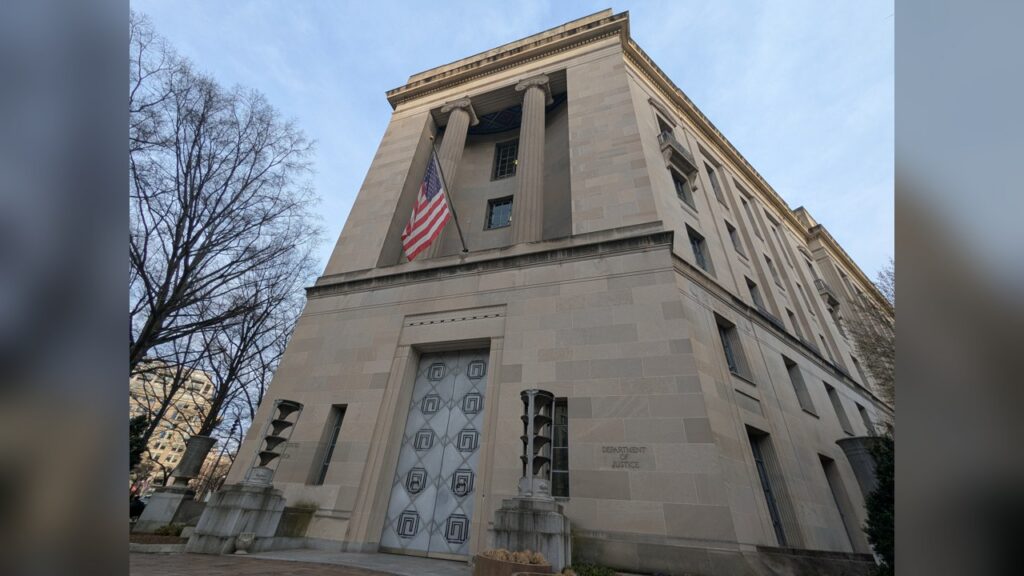
 Ryan M. Biller, U.S. Department of Justice (Public domain) via Wikimedia Commons
ProPublica found that Blanche held between $159,000 and $485,000 in cryptocurrency and Coinbase stock when, roughly one month into his tenure and before divesting, he issued the memo ending DOJ’s crypto investigations and eliminated the National Cryptocurrency Enforcement Unit entirely. His ethics agreement required him to sell the crypto within 90 days and to avoid participation in any matter affecting those financial interests until he did. Virginia Canter, an ethics lawyer who served under four presidents, called it “an obvious conflict of interest.” That is 18 U.S.C. § 208, and the willful variant under § 216 carries up to five years.
His financial disclosure reports $490,000 in partnership payments from his old law firm while serving as a federal official. The Office of Government Ethics has written, in guidance that anyone in this field has read, that post-appointment partnership payouts can violate 18 U.S.C. § 209, which bars federal officials from accepting salary supplementation from any source other than the government. The statute is not ambiguous. It was written for precisely this circumstance.
Then there is the settlement. Blanche personally signed the deal resolving Trump’s lawsuit against the IRS, which included a $1.776 billion “Anti-Weaponization Fund” to compensate Trump allies, including January 6 defendants, and granted Trump, his family, and his businesses immunity from tax audits. A federal judge subsequently ruled the entire arrangement collusive, writing that Trump’s lawyers and DOJ attempted to use the court to “earmark billions of dollars from American taxpayers to redress grievances not defined in the law.” She described Blanche’s congressional testimony as “at best, misleading and, at worst, disingenuous” and sent disciplinary referrals to state bar associations. When that same judge ordered a sworn declaration within one week confirming the fund’s cancellation, the department did not provide it. That is 18 U.S.C. § 401, contempt of court, and arguably § 1505, obstruction of proceedings.
The department’s own top ethics lawyer directed Blanche to recuse from matters involving Trump personally. He did not. At his first press conference as Acting Attorney General, he told the president, “I love you, sir.” His aide told all 93 U.S. Attorney’s Offices that Trump was their “chief client.” He boasted at CPAC that DOJ had fired more than 200 prosecutors and agents who worked on cases involving Trump. Under his leadership, more than 16,000 employees have left the department, including a quarter of its attorneys.
 Bill Cotterell (Public domain) via Wikimedia Commons
The literature on institutional capture is extensive. Scheppele, Levitsky and Ziblatt, Bermeo: all describe the same pattern. The autocrat does not need to abolish institutions. He needs to install someone who treats the institution as an extension of his personal legal interests, and then wait for the career civil servants to leave. Sixteen thousand departures is not attrition. It is a purge by any reasonable operational definition.
What makes the Blanche case distinctive is not the corruption. Corruption is a constant in executive politics. What is distinctive is the documentation. The conflicts are on his disclosure forms. The memo disbanding crypto enforcement is a public document. The settlement he signed is a court filing. The judge’s ruling is published. The ethics guidance he ignored is written guidance from his own department. This is not inference. It is a paper trail that a first-year law student could prosecute.
And yet no investigation exists, because the investigator would have to investigate himself. This is the structural paradox of captured institutions: the more complete the capture, the more invisible the accountability mechanism becomes. The Senate confirmed him knowing all of this. Collins and Murkowski objected. Cassidy, Cornyn, and Tillis extracted written promises and then voted yes anyway, which is a pattern of concession under pressure that political scientists have a term for. It is called accommodation, and the literature is clear about where it leads.
A ruling party that faces no consequences for documented criminal conduct by its chief law enforcement officer has no structural incentive to accept electoral outcomes it dislikes. That is not speculation. That is the finding of every comparative study of democratic backsliding published in the last fifteen years. The question is not whether Todd Blanche should be charged. The public record supplies probable cause on at least four statutes. The question is whether any institution remains capable of charging him, and that question, I am afraid, answers itself.