


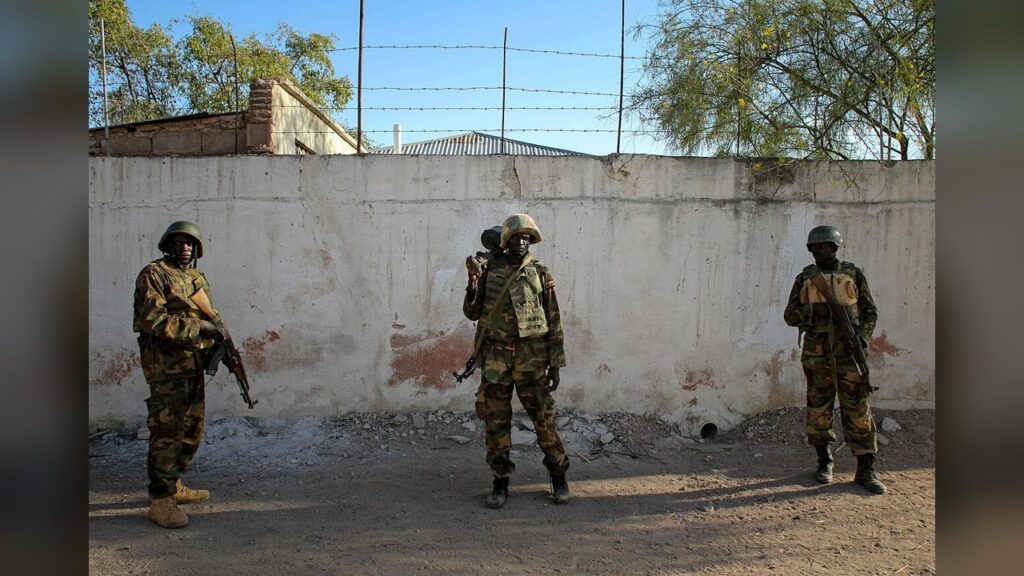
Soldiers and airmen stood at the back of a black minivan, arming themselves with garbage bags and red-handled trash pickers, and headed for the park around the recreation center. This was the 119th beautification project completed by the D.C. National Guard contingent since August, when President Trump declared a “crime emergency” and launched what he called the D.C. Safe and Beautiful Task Force. One year later, the deployment has been quietly extended to Inauguration Day 2029. The troops patrol Metro stations. They pick up litter. They refurbish recreation centers. And in the gentlest possible terms, I would like to suggest that a republic which finds itself comfortable with this has already lost something it will struggle to name.
 Rhododendrites (CC BY-SA 4.0) via Wikimedia Commons
Let us begin with the pretext. Trump ordered the deployment after declaring a crime emergency, despite violent crime being at a 30-year low. This is not a controversial observation. It is simply what happened. The deployment was a solution in search of a problem, or more precisely, a solution in search of a justification that did not yet exist and has since been manufactured through a combination of selective enforcement and, as it turns out, fabricated data. In May, 13 Metropolitan Police Department employees were placed on leave after the district’s inspector general determined that crime statistics had been manipulated over several years to show favorable trends. The very baseline against which the Guard’s “success” is now being measured was, by the district’s own admission, rigged. One does not need a doctorate to find this troubling, though apparently it helps.
The White House boasts of 16,000 arrests. U.S. Attorney Jeanine Pirro, whose confirmation in August 2025 marked the federal takeover of D.C. prosecutions, claims her office’s caseload has risen 67 percent. What the White House does not boast about is the string of acquittals and dismissed cases that followed. Pirro has been forced to abandon vandalism charges against at least four defendants. She failed to secure grand jury indictments against Sen. Mark Kelly and five former military and intelligence officers now serving in Congress. Jurors in this deep-blue city have rejected the government’s arguments in multiple politically sensitive cases, a pattern legal experts have described as jury nullification. The residents of Washington, in other words, are not merely skeptical of the deployment. They are actively refusing to convict within it. This is what democratic resistance looks like when your city has no voting representation in the body that authorized your occupation.
 Gage Skidmore from Surprise, AZ, United States of America (CC BY-SA 2.0) via Wikimedia Commons
And occupation is the correct term, or at least the term D.C. Attorney General Brian Schwalb used in his brief arguing that the Guard units are operating “as a federal military police force.” His lawsuit challenging the deployment will be heard this week. Mayor Muriel Bowser, walking her familiar tightrope between appeasement and resistance, has acknowledged that crime is down while noting that out-of-state Guard troops are not “an efficient use of those resources.” She is correct on both counts, which is the tragedy of her position. The deployment has produced measurable effects. It has also produced a woman detained on her own property by troops she says treated her violently, a man arrested for playing the Darth Vader theme song in protest, and one National Guardsman from West Virginia shot dead at Farragut West station by an Afghan national the authorities describe as mentally ill.
Brig. Gen. Leland Blanchard II, the D.C. Guard’s interim commanding officer, says the deployment will continue “until the president determines it’s time for us to go do something different.” Read that sentence again. The duration of a military presence in an American city is determined solely by the personal discretion of the president who ordered it. There is no statutory endpoint. There is no congressional review. There is no sunset clause. There is only the president’s sense of when the troops should “go do something different,” a phrase so casually imperial it would have made the authors of the Posse Comitatus Act reach for their smelling salts.
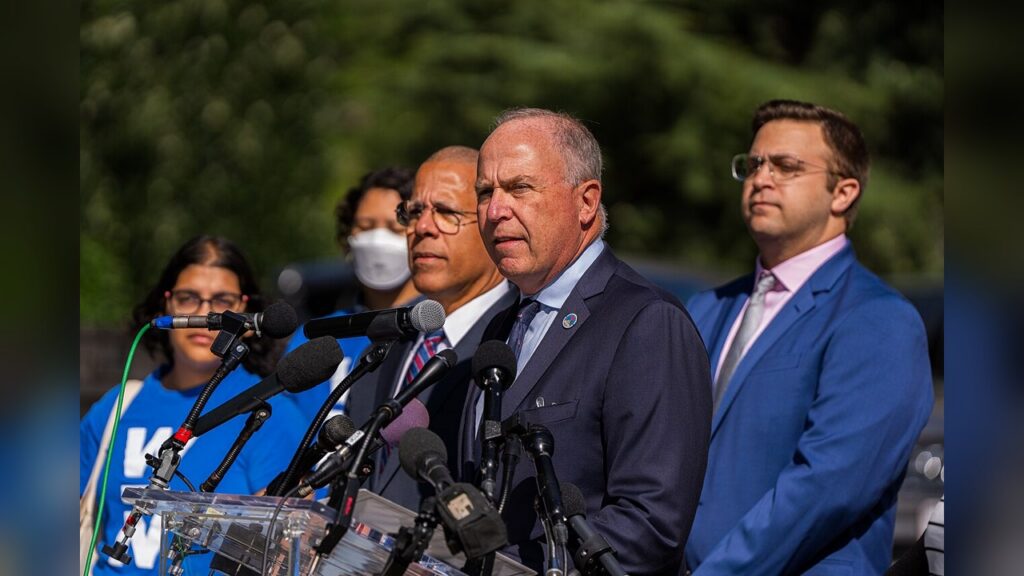 Maryland AG (CC BY 2.0) via Wikimedia Commons
Some residents, we are told, feel safer. A man outside the VA building saw Guard members provide first aid at a bus stop. A woman at Farragut North feels “100 percent” secure. A 74-year-old tenant association leader simply wanted her park cleaned, and the Guard cleaned it. I do not doubt their sincerity. I merely note that comfort with garrison governance tends to deepen gradually, and that the residents of occupied cities throughout history have always found reasons to be grateful for the soldiers who clean their parks, until the day they don’t.