


The Empire That Invented Drones Forgot to Build Any
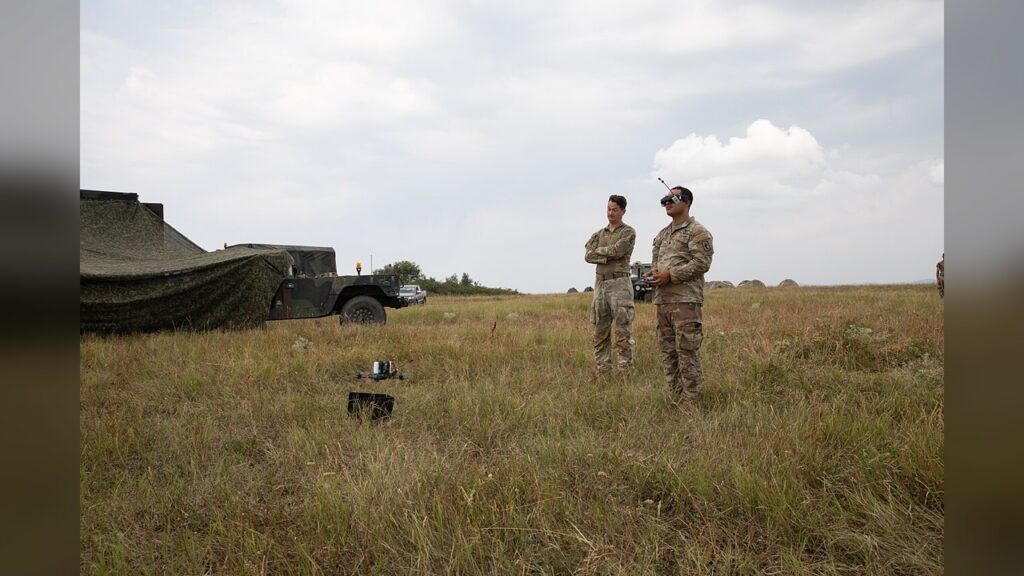
There is a concept in institutional sociology called “path dependency,” and if you have never encountered it, the Pentagon would be delighted to show you how it works in practice. The United States military, which pioneered unmanned aerial vehicles, which built the Predator and the Reaper and an entire doctrinal apparatus around them, recently sent 3,700 troops from the 3rd Armored Brigade Combat Team to a training exercise in Germany called Combined Resolve. They were defeated so thoroughly and so quickly by Ukrainian drone operators that American soldiers had to be “re-spawned,” in the language of the exercise, and sent back onto the field so the thing could continue. An entire U.S. armored brigade was eliminated in a single iteration. One assumes the respawn mechanic was not part of the original scenario design.
 Ansgar Koreng (CC BY-SA 4.0) via Wikimedia Commons
The details, reported by The Wall Street Journal and confirmed to The Independent, are less embarrassing than they are instructive. Ukraine has spent more than four years in grinding, full-scale conventional warfare against Russia. It has iterated. It has failed, adapted, failed differently, and adapted again. One Ukrainian manufacturer plans to produce more than three million first-person-view drones in 2026. The United States built 300,000 in 2025. That is not a gap. That is a different category of industrial commitment entirely.
And yet President Trump, asked in March about Ukrainian offers to supply counter-drone technology, told Fox News: “We don’t need their help in drone defense. We know more about drones than anybody. We have the best drones in the world, actually.” That “actually” is doing a great deal of work in that sentence, none of it epistemic. Eighteen American service members have been killed since Trump launched his war against Iran on February 28, six of them in a single Iranian drone strike on a civilian port in Kuwait. The best drones in the world, it turns out, were not sufficient to prevent that.
Secretary of Defense Pete Hegseth, to his marginal credit, acknowledged the problem in a July 10 memo, conceding that U.S. forces lack “the lethal small drones that the modern battlefield requires” because America had fallen behind in “harnessing technologies we invented but were slow to pursue.” This is, as the scholars of innovation policy would say, a rather precise diagnosis of the disease. One wishes it had arrived before the casualties rather than after. Hegseth also told a Senate committee he had dispatched strategists to Ukraine to study drone combat, following Senator Mitch McConnell’s characterizations of that country as the “Silicon Valley of warfare.” McConnell, in this instance, was not engaging in hyperbole. Ukraine’s National Security Council projects a defense production capacity of $55 billion next year. The country currently has funds for about $15 billion. The gap between what they can build and what they can afford is precisely the gap American financing could close, which is why a draft memorandum between Kyiv and Washington on a drone defense deal is now under review at multiple institutional levels.
 U.S. Army photo by Staff Sgt. Jamie Robinson (Public domain) via Wikimedia Commons
The Ukrainians, it should be noted, also switched sides midway through the Germany exercise and taught American forces how to use drones offensively. The U.S. troops improved over two weeks, learning to disperse, conceal, and deploy electronic warfare. This is the small consolation of any well-designed exercise: you lose, you learn, you lose less badly. But the structural problem remains. A defense procurement system optimized for multi-decade, multi-billion-dollar platforms cannot produce three million cheap attritable drones on an annual cycle. The institutional architecture is wrong. The incentives are wrong. And the commander in chief insists, against all available evidence, that everything is already the best.
Eliot Cohen, former Pentagon civilian adviser and now a defense expert at the Center for Strategic and International Studies, put it with the weary precision of a man who has been briefing this for years: “It is vital that the U.S. military master that, and thus far, unfortunately, that does not seem to be the case.” One does not need a doctorate in organizational behavior to understand what happens next. You either learn from the country that has been doing it under fire, or you continue to be respawned.