



It is, I suppose, a measure of where we are as a polity that it took a podcast host to say what every presidential ethics office, every congressional oversight committee, and every respectable editorial board should have been shouting since January. Joe Rogan, a man who endorsed Donald Trump in 2024 and whose audience skews toward young men who regard “institutional credibility” as an oxymoron, looked at the Trump family’s cryptocurrency ventures and arrived at the conclusion that the rest of us reached some time ago. “Trump has made billions in crypto,” Rogan said on a recent episode of his show. He called it “nuts.” He called it “shady as f***.” He acknowledged, in the same breath, that it remains perfectly legal.
That last concession is the part that should trouble anyone inclined to celebrate Rogan’s belated clarity. The problem was never that the Trump family broke the law. The problem is that the law was deliberately shaped to permit exactly this.
Records compiled by Newsweek show roughly $1.4 billion in profits connected to Trump’s crypto ventures, spanning the meme coin, various digital-asset projects, and the business activities of his sons. Since returning to office, Trump has promoted policies designed to make the United States a global hub for digital assets. The regulatory framework governing those assets is, at this moment, being written by an administration whose family stands to collect more from the sector than any prior president has reported from any single industry while in office. Previous occupants of the White House, as the political analyst quoted by Newsweek correctly observed, placed assets in blind trusts or stepped away from active business. This is not a deviation from a norm. It is the demolition of one, conducted in plain view, with the demolition permit issued by the demolisher himself.
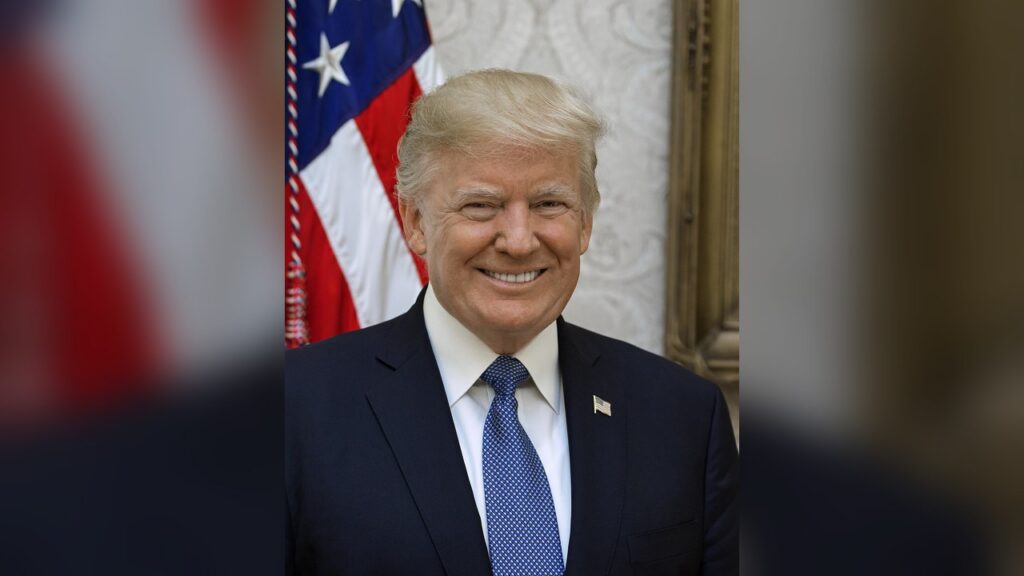 Shealeah Craighead (Public domain) via Wikimedia Commons
The White House, for its part, says there is no issue. Deputy press secretary Anna Kelly presumably delivered this assurance with the straight face the job requires. One does not blame the spokesperson. One blames the system that makes the spokesperson necessary.
What is genuinely interesting here is not Rogan’s commentary, which amounts to a man walking into a burning building and noting the warmth. It is the friction his remarks have produced among his audience. A vocal slice of Trump’s podcast-oriented base, younger men who followed Rogan’s endorsement to the ballot box, appears willing to question whether a president’s family should extract $1.4 billion from an industry he is simultaneously deregulating. This is, in the language of political science, a small but non-trivial crack in the coalition’s informational cohesion. Whether it widens depends on whether the discomfort survives contact with the broader conservative movement’s hierarchy of priorities, which has historically ranked tax cuts, judicial appointments, and cultural grievance well above financial ethics.
Rogan will not fracture that coalition. He knows it. His listeners probably know it too. But the moment a figure with his reach names the thing aloud, the thing becomes slightly harder to pretend away. The academic literature on elite capture and regulatory entry is extensive and, at this point, largely decorative. We have known for decades that when the regulated write the regulations, the public interest tends to finish second. What we lacked was a podcaster willing to say it in language that his audience would actually hear.
 Markus Winkler / Pexels
So welcome to the conversation, Joe. The rest of us have been here for some time, faintly exhausted, waiting for the microphone to turn our way.