


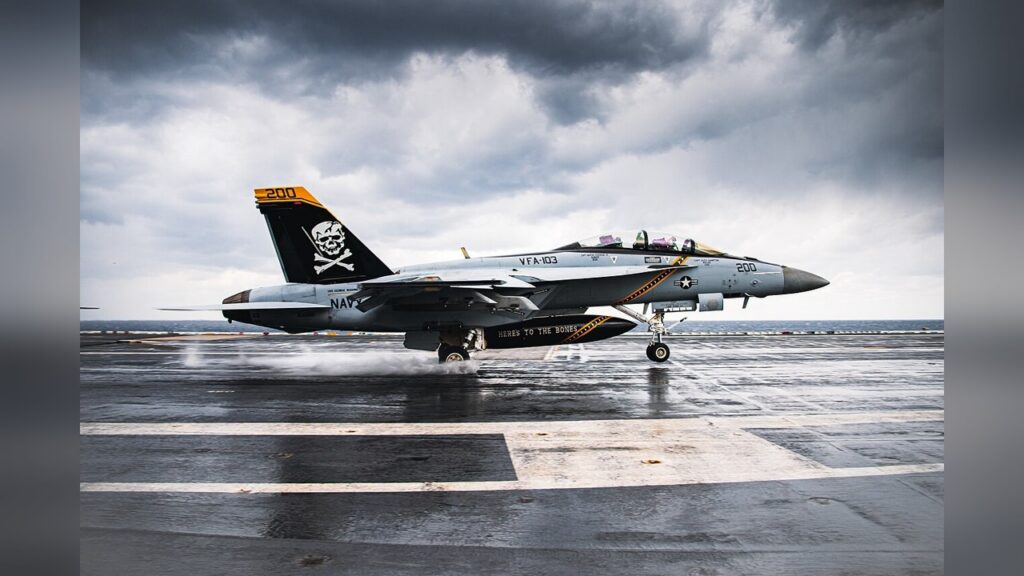
The Pentagon is sending the USS George Washington to the Middle East, and if you read the official framing, this is a routine rotation, a scheduled relief, a perfectly ordinary piece of naval choreography. I would invite you to sit with that word “routine” for a moment, because what it is routine-ing over is the fact that the ship being relieved, the USS Abraham Lincoln, has spent 250 consecutive days at sea without a port call. That is a modern record for an American aircraft carrier. Records of this kind are not achievements. They are symptoms.
The Lincoln was supposed to deploy to the Pacific. It left San Diego on November 21 and was rerouted to the Middle East when the war with Iran began. Since then, its crew of more than 5,000 has touched land exactly twice: two days in Guam in December, two days in Oman in July. Rep. Mike Levin of California, whose district includes the Lincoln’s homeport, described conditions on the ship in terms that would be familiar to any student of nineteenth-century naval hygiene: moldy showers, broken toilets, laundry down for weeks, no hot water, a meal that amounted to half a cup of rice and two tortillas. No soap, no deodorant, no toothpaste. The Navy’s official response is that current reports from the ship confirm “continuous access to clean water, functional AC and healthy meal options,” which is the kind of institutional statement that does more damage to its own credibility than any congressional press release could.
Then there is the matter of sailors attempting to jump overboard. The Navy Times and Stars and Stripes have both reported multiple such incidents. At a town hall in San Diego last Thursday, roughly 200 family members confronted the acting Navy secretary, Hung Cao. One spouse said her husband had texted her that morning saying he hoped he would not wake up tomorrow. Another woman told Cao the Navy had “broken trust between us and the leadership.” These are not anonymous internet complaints. These are names, faces, and congressional testimony.
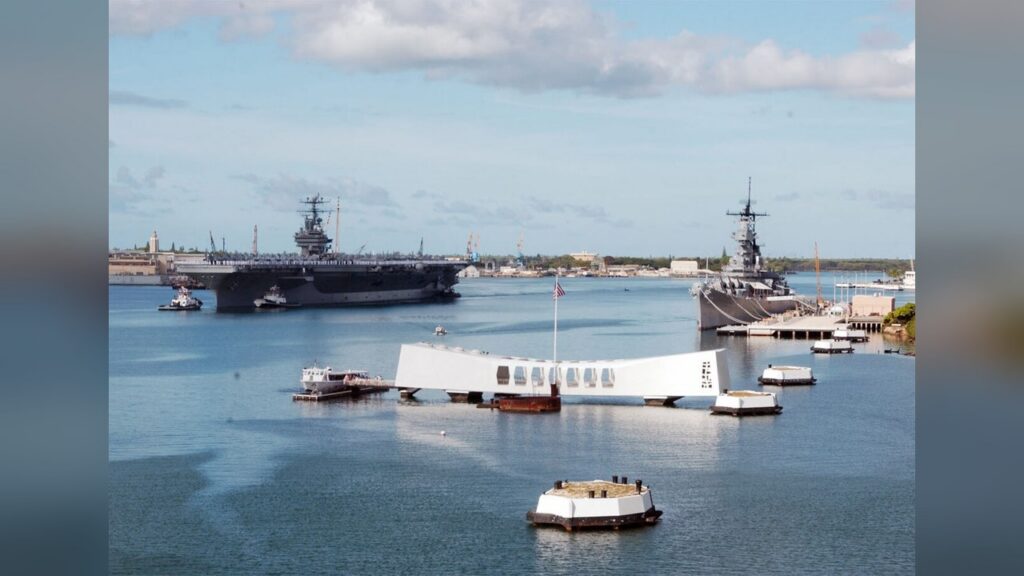 United States Navy Photographer's Mate 3rd Class Kittie VandenBosch (Public domain) via Wikimedia Commons
Defense Secretary Pete Hegseth’s contribution to this discourse was to dismiss the earlier reports as “more fake news.” Levin’s response was appropriately withering: these men and women signed up to serve, and the least their country owes them is hot water, a working toilet, and a real meal. Hegseth cannot manage that, and he has the nerve to call their families liars. One does not need a doctorate in organizational behavior to recognize that when a cabinet official responds to documented supply failures and suicide attempts with a tweet-length dismissal, the problem is not merely logistical. It is structural. The system was designed for a short war. The war was not short. Nobody adjusted.
And here is where the complication compounds itself, because the George Washington is not really a solution. It is a placeholder. The Washington has already been deployed since May. The USS Bush has been in the region since March. Maintaining two carrier strike groups in the Middle East is depleting munitions and degrading readiness across the fleet, including in the Pacific, where INDOPACOM now faces its own gaps. The literature on military overextension is not ambiguous on this point. A study last year surveying deployed sailors found that nearly half reported inadequate help coping with stress at sea, and the authors concluded, with the understated urgency characteristic of peer-reviewed work, that efforts to improve healthcare access on ships are “urgently needed.” That was before 250 days without a port call.
Oil markets, meanwhile, registered the deployment with a 2 percent jump in Brent crude to near $85 a barrel, because roughly a fifth of global oil passes through the Strait of Hormuz and markets price uncertainty whether the Pentagon does or not. Iran’s Revolutionary Guard has called the carrier a “target.” This is the architecture of escalation: each deployment intended to deter, each one also raising the stakes, each one fitting a pattern visible in 2019 and again after the killing of Qasem Soleimani, when carriers were rushed to the Gulf and then, eventually, quietly drawn down after the crisis passed or shifted form.
The Pentagon has announced no timeline for the George Washington’s mission. That ambiguity is called “leaving room for diplomatic maneuvering.” Another term for it would be having no plan. The Lincoln’s crew learned the difference.