


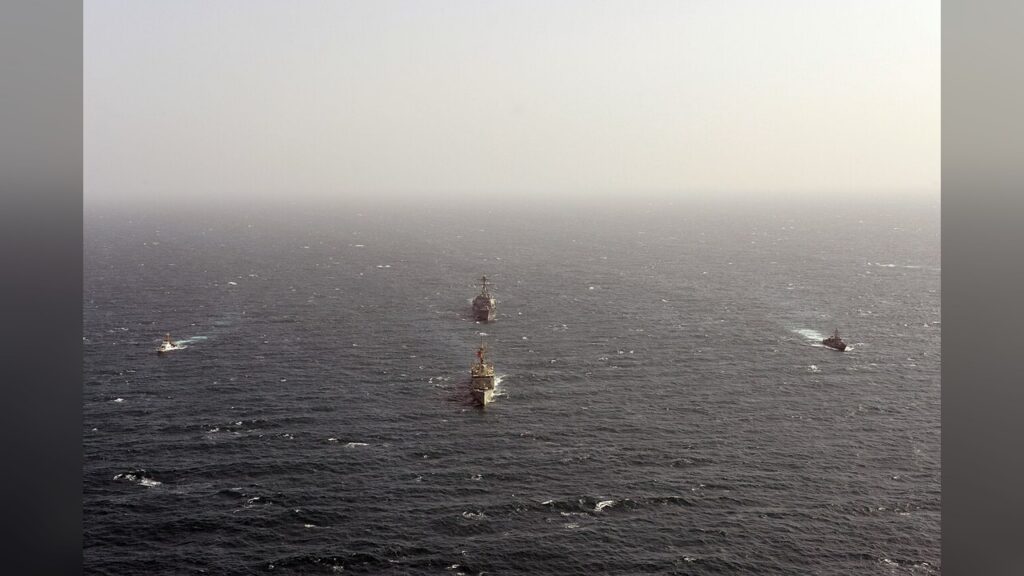
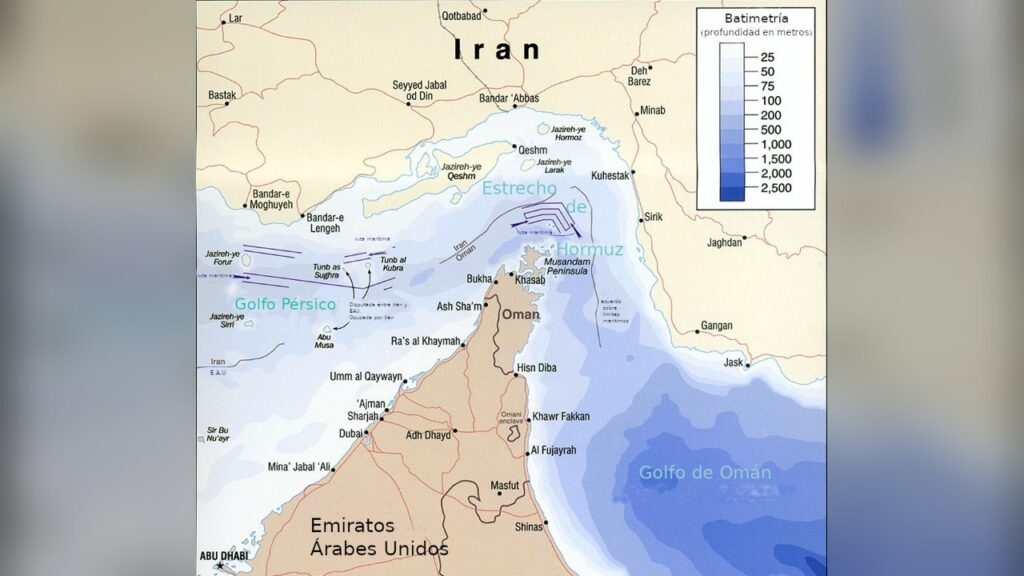
There is a particular kind of imperial cognition, well-documented in the literature on great-power overextension, in which a leader confuses the temporary projection of force for durable sovereignty. Donald Trump stood before a crowd in South Carolina on Friday and declared the Strait of Hormuz “American territory.” Not a shipping lane under temporary naval interdiction. Not a chokepoint where the United States exercises freedom-of-navigation operations. American territory. He said it twice, in fact, once at a New York police academy last week and again on Monday to reporters, and then he posted a map to social media labeling the waterway accordingly. Iran’s deputy foreign minister, Kazem Gharibabadi, called the remarks “delusions,” which is the sort of diplomatic understatement that functions as its own genre of analysis.
One might be tempted to treat this as mere rhetorical excess, the familiar Trumpian gesture of saying the quiet part in a bullhorn. But the territorial claim accompanies an actual blockade. American forces have redirected 68 commercial vessels as of Friday, according to U.S. Central Command. Roughly one-fifth of the world’s seaborne oil supply typically transits that waterway. The United States is now gatekeeping a strait it does not border, between nations it is not, and calling the arrangement governance. The historical analogues are not encouraging.
Meanwhile, Trump joked about bombing Iran. “What the hell do I have to do? Go back and bomb Iran a little bit more?” he asked the South Carolina crowd, before reciting “The Snake,” a poem he deploys at rallies to underscore his anti-immigrant posture, as though the two subjects belong in the same rhetorical envelope. The casualness is not an accident. It is the performative style of a power that has stopped distinguishing between coercion and policy, between a Friday night rally bit and a decision that moves carrier groups.
The economic architecture beneath the bluster is more interesting than the bluster itself, and considerably more consequential. Treasury Secretary Scott Bessent has vowed to impose “the toughest sanctions in history” to “collapse” the Islamic Republic. The structural problem, as former Treasury official Miad Maleki explained to CBS News, is that approximately 80 percent of Iran’s foreign currency exchange runs through Dubai. Iran sells oil to China, generates revenue, and moves portions of those funds through Emirati exchange houses into jurisdictions where they become accessible. Dubai has functioned, for years, as a pressure valve in the sanctions apparatus, a gleaming financial center whose opacity is not a bug but a feature of its regional role.
The Treasury has begun targeting that infrastructure. Dubai-based HMS Trading FZE was designated for its role in helping Tehran retrieve overseas oil revenue. Shahr Bank, linked to the Islamic Revolutionary Guard Corps, relied on two Dubai currency exchange firms to launder money, according to the Treasury’s August 7 statement. Secondary sanctions now threaten foreign banks that knowingly transact with the named shell companies. This is the part of the campaign that could actually produce leverage, because it attacks the plumbing rather than the rhetoric.
 CIA (Public domain) via Wikimedia Commons
And the UAE, for its part, appears to have reached its own threshold. After Iran launched two ballistic missiles at Emirati territory and attacked an Abu Dhabi National Oil Company vessel in the strait, UAE Ministry of Foreign Affairs spokesperson Afra Al Hameli announced that “all trade, commercial exchanges, and financial transactions with Iran have been halted until further notice.” Maleki’s reading is that the Emiratis were absorbing economic hits from Iran’s escalation while waiting for Washington to negotiate an end to the conflict, and concluded that passivity was no longer affordable. That is a rational calculation, and it is the kind of structural shift that matters more than a map posted to social media.
The difficulty, of course, is that the Trump administration is simultaneously running a naval blockade, declaring international waters sovereign U.S. territory, joking about additional bombing runs, and asking a Gulf state to sever financial ties with its neighbor across the water. These are not complementary instruments. A sanctions regime requires coalition maintenance, institutional patience, and a theory of how economic pressure converts into political outcomes. A territorial claim over a strait 7,000 miles from Washington requires none of those things, which is precisely why it is so easy to announce and so difficult to sustain. The literature on coercive diplomacy is quite clear on this point: when the performative dimension overwhelms the structural one, the target state typically calculates that the coercer lacks the discipline to follow through on the boring, grinding work of enforcement. Iran’s Foreign Ministry has already called the latest sanctions “a declaration of war on all nations,” which is hyperbolic, but it signals that Tehran reads the American posture as theater backed by force rather than force backed by strategy.
None of this is to suggest that the sanctions architecture is futile. The Dubai pipeline is real, the shell companies are real, and the UAE’s decision to halt transactions is a genuine structural shift. But the distance between designating a Dubai-based front company and collapsing a regime is the distance between tightening a tourniquet and performing surgery. The Trump administration has shown considerable enthusiasm for the tourniquet. The surgery remains unscheduled.