


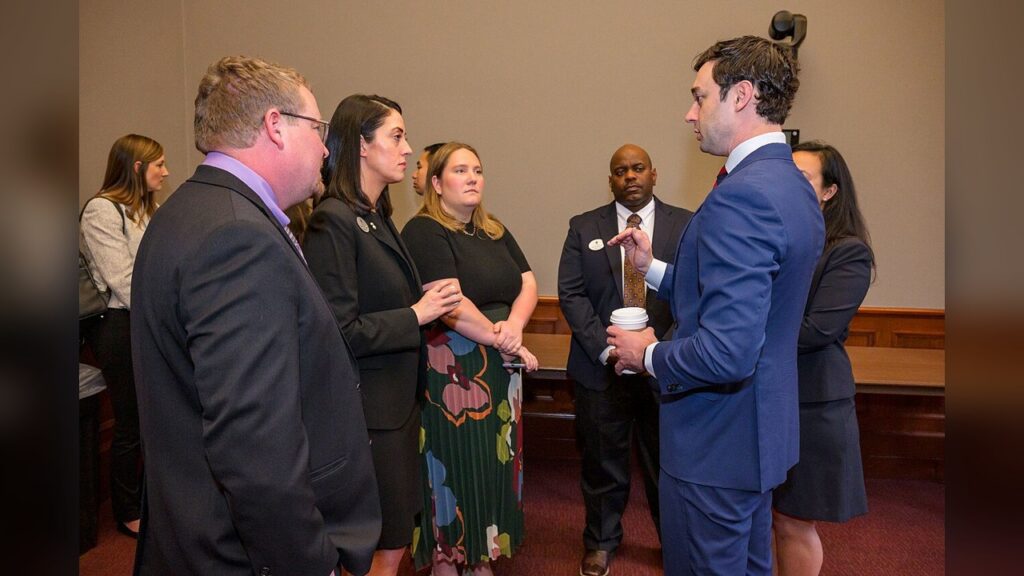
There is a particular species of political rhetoric that functions not as insult but as diagnosis, and Senator Jon Ossoff’s remarks at a Tuesday campaign stop in Georgia belong firmly to that category. Standing alongside Senator Mark Kelly and former Congresswoman Gabrielle Giffords, Ossoff delivered what the press has dutifully transcribed as a “blistering takedown,” though the more precise framing would be that he named, in plain English, a structural inversion that has been building for the better part of a decade.
“I don’t think anything illustrates the times more aptly than that the draft-dodging, crook president, who has plunged our nation recklessly into a war he knows not how to end or to win, tried to imprison this man, who embodies American heroism.” The sentence is ungainly. The observation is not.
Consider the institutional architecture Ossoff is describing. A president who received five draft deferments during the Vietnam era, a matter of public record and not in serious dispute, now presiding over a military engagement against Iran that he neither prepared for nor appears capable of concluding. That same president publicly demanded the arrest of six Democratic lawmakers, Kelly among them, after they released a social media video reminding service members that they are not obligated to obey illegal orders. Trump’s response, characteristically rendered in capital letters, accused them of “SEDITIOUS BEHAVIOR, punishable by DEATH!”
The principle Kelly and his colleagues articulated is not a partisan innovation. It is codified military law, established at Nuremberg and reinforced through decades of American jurisprudence, that uniformed personnel bear no duty to carry out unlawful commands. A president calling for the imprisonment of elected officials for restating that doctrine is not, strictly speaking, a scandal. It is a constitutional stress test, and the fact that it produced no formal censure, no Senate resolution, no institutional response beyond collective shoulder-shrugging, tells you considerably more about the condition of American governance than any single tweet could.
Ossoff, who is running for re-election in Georgia and is widely, perhaps prematurely, speculated to be positioning for a 2028 presidential bid, has been escalating his rhetoric against Trump across multiple appearances. At a Sunday event in Atlanta, he attacked the administration’s handling of the US-Israel war on Iran with a specificity that bears quoting: “While the sailors on the Lincoln fight his war, while he fruitlessly drains our munitions and oil reserves, the president sleeps through his meetings. He golfs and trades stocks.” He referenced, with visible contempt, the Qatari gift of a Boeing 747 to the Trump administration, calling it a “defenseless flying palace.”
One could quibble with the rhetorical register. The phrase “draft-dodging, crook president” is not language that would appear in a peer-reviewed analysis of executive power. But the underlying claim, that a president who avoided military service has now both prosecuted an ill-defined war and attempted to criminalize the recitation of established military law by decorated veterans, describes a pattern that scholars of democratic erosion would recognize from comparative literature. It is the pattern of an executive who treats institutional constraints as personal affronts and military norms as negotiable preferences.
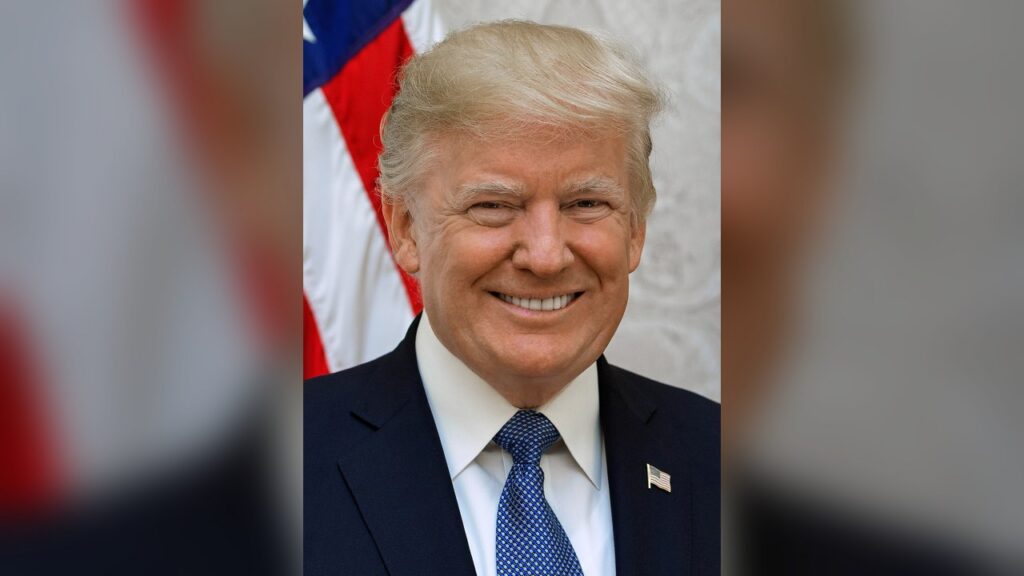 Shealeah Craighead (Public domain) via Wikimedia Commons
What is notable is not that Ossoff said it. It is that saying it remains, in 2026, treated as remarkable. The normalization of the abnormal has proceeded so thoroughly that a senator accurately characterizing a president’s documented conduct generates viral attention. The bar for democratic alarm has been lowered so far that merely clearing it constitutes news.
That, more than any single epithet, is the thing worth examining.