


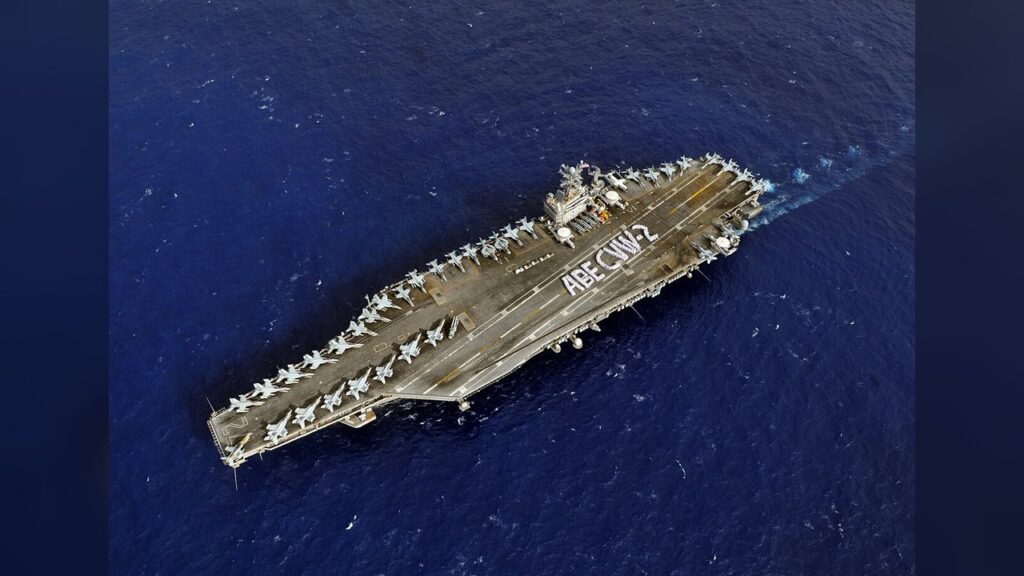
There is a well-established body of literature in military sociology, stretching from Moskos’s work on occupational versus institutional models of service through the post-9/11 deployment studies that Nancy Youssef and others have documented at length, on what happens to a crew when a carrier stays at sea past the point of reasonable endurance. The Navy knows this literature. The Pentagon has internal data. And yet on Friday, the President of the United States, asked about the USS Abraham Lincoln and its record-setting 240-plus consecutive days at sea, said the deployment was “not nearly long enough.”
One pauses. Not at the cruelty, which is by now structural rather than surprising, but at the casualness. Trump delivered the line on his way to a crime-rate photo op in Garden City, New York, a venue chosen to project domestic normalcy while 5,000 sailors sit in the Arabian Sea under conditions their own families have been describing to Democratic lawmakers. Senator Blumenthal and Senator Gallego are pressing for accountability. Representative Jason Crow, who served three combat tours with the 82nd Airborne and the 75th Ranger Regiment before entering Congress, wrote plainly that Trump “does not care about our servicemembers or their families.” The Republican chairmen of the House and Senate armed services committees, it bears noting, had nothing to say. The literature on institutional silence in the face of executive overreach is also well established.
 Shealeah Craighead (Public domain) via Wikimedia Commons
Defense Secretary Pete Hegseth called reports of deteriorating conditions aboard the Lincoln “completely misrepresented.” The Navy, asked about mental health concerns, said it has “not observed an increase in suicidal ideations or attempts” but declined to provide data, citing operational security and patient privacy. A sailor went overboard in early August. The Navy recovered him, treated him, transferred him off the ship, and would not say whether it was a suicide attempt. One does not need to be a clinical psychologist to read the institutional posture here: the data exist, the data are being withheld, and the withholding is itself a form of communication.
Trump entered his second term promising to avoid lengthy military entanglements. The Iran war, launched alongside Israel on February 28, was supposed to last weeks. It is now more than five months old. On Friday, Trump acknowledged he has used the military “a little bit more than I wanted to,” then joked that he might soon “declare the Hormuz Strait a territory of the United States.” He said, “I’ll never apologize. I did the right thing.” The oil price disruptions that have followed the blockade of Iranian ports, the strain on naval readiness across two carrier strike groups in the region, the open-ended commitment that Hegseth says can be maintained “indefinitely”: none of this registers as cost in the President’s framework. It registers as resolve.
What we are watching is not a policy dispute. It is the collision of a personnel system designed around predictable rotation cycles with a commander in chief who treats those cycles as suggestions and the people inside them as props. The Abraham Lincoln is being replaced by the USS George Washington, which itself just left port in Da Nang. The relief is coming, eventually, in the way that tectonic processes are eventually coming. Acting Navy Secretary Hung Cao posted that the Lincoln “will return home soon.” Soon is not a date. Soon is what you say when you do not have a date.
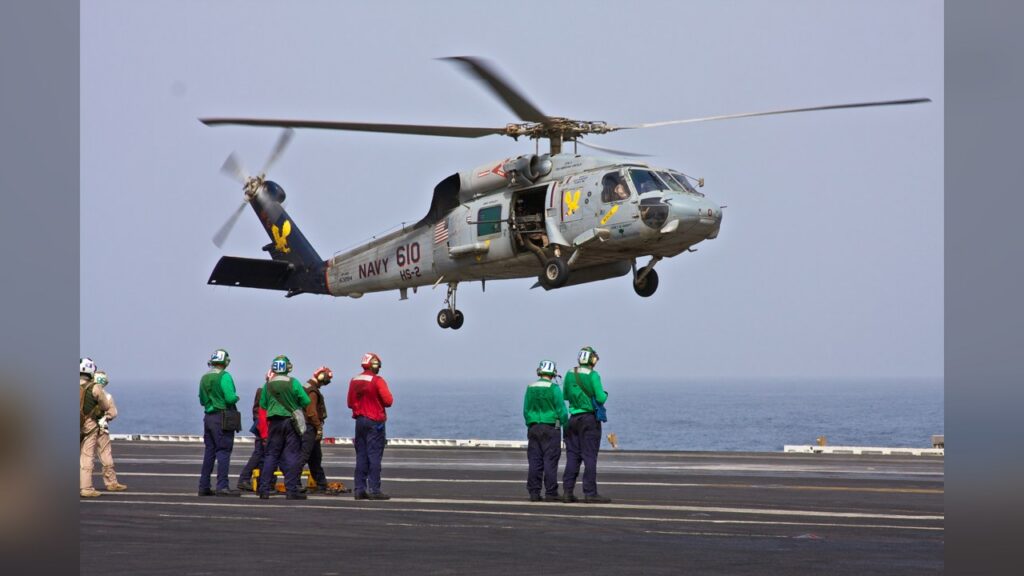 Lutz Gretschel (BY-SA) via wikimedia
The structural problem is straightforward and has been documented across multiple post-Cold War deployment cycles: when the operational tempo exceeds the force structure, the gap is filled by the bodies of junior enlisted personnel who have no institutional voice. Trump’s “not nearly long enough” is not a gaffe. It is an accurate description of how this system actually works, spoken by the one person with the authority to change it and no intention of doing so.
TIME: How serious are Iran’s threats against Trump?