



There is a well-established literature on what political scientists call “positional goods,” commodities whose value derives not from their utility but from their capacity to signal status. One might have assumed the United States Navy, an institution with a budget exceeding $800 billion and a global mission set, would be insulated from such logic. One would be wrong.
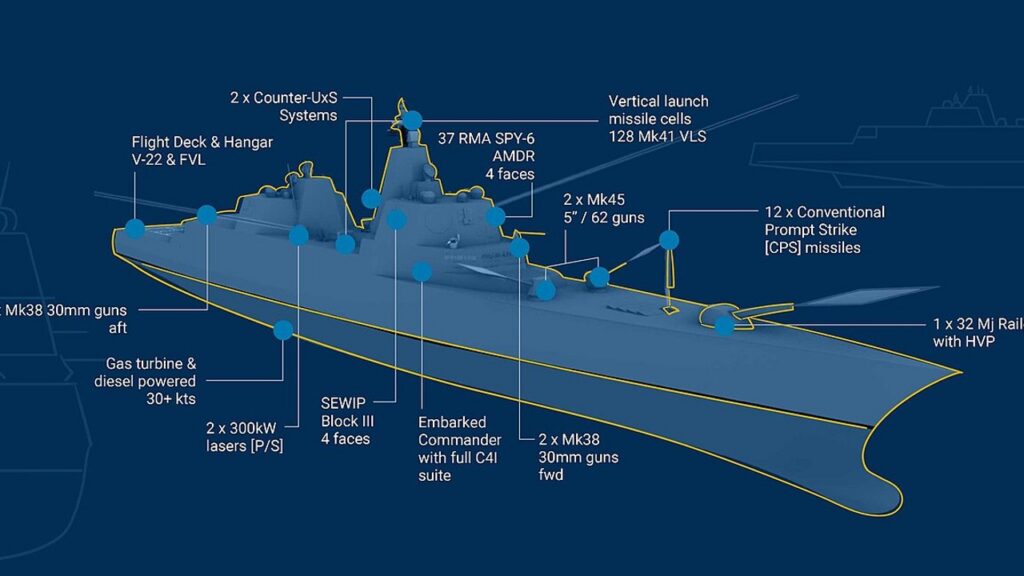
President Trump has announced the construction of a “Golden Fleet” headlined by the Trump-class USS Defiant, a battleship he claims will be “100 times more powerful than any battleship ever built.” He approved two to start, with plans for up to 25. He was flanked, at his Mar-a-Lago club, by Defense Secretary Pete Hegseth, Secretary of State Marco Rubio, and Navy Secretary John Phelan, standing beside posters of renderings like a developer unveiling a new condo tower.
 Shealeah Craighead (Public domain) via Wikimedia Commons
The battleship, as a class of vessel, has not been built by any major navy since the 1990s. The last American battleships were decommissioned because they were obsolete: enormous, slow, and vulnerable to the precise kind of anti-ship missiles that the Navy has spent two decades trying to counter. Trump’s promise of hypersonic weapons aboard a platform whose basic concept was retired before most current sailors were born is, to put it in the most generous academic terms, a category error.
But the Trump-class announcement is the headline. The deeper institutional story is the carrier redesign. Seven current and former officials told The Washington Post that the Navy is evaluating whether to relocate the “island” (the multistory command tower on Ford-class carriers) from the rear of the ship to the middle. The reason is not operational. It is aesthetic. Trump prefers the World War II look.
 U.S. Navy (Public domain) via Wikimedia Commons
The island sits at the rear for specific, studied reasons: it gives aircraft more parking room near the catapults and reduces air turbulence for landing planes. Bryan Clark, a senior fellow at the Hudson Institute and hardly a dove, noted that moving it would disrupt the vessel’s weight and buoyancy. A similar study conducted during Trump’s first term concluded the change would cost billions and cause major program delays. “It came back that the cost and time to do so would just be extraordinary,” a former senior official told the Post. So the Navy is now re-studying what it already studied, because the man who asked the question the first time is asking it again.
And then there is the presidential memorandum directing the Navy to strip the Electromagnetic Aircraft Launch System from the future USS Doris Miller and revert to steam and hydraulic catapults. The EMALS system, whatever its teething problems, represents the direction every modern carrier program is moving. The memorandum calls for “proven, reliable, and affordable technologies,” which is a reasonable principle if one ignores that the steam catapults being restored are themselves maintenance-intensive relics of the 1950s.
 Official U.S. Navy Page from United States of America Chris Oxley/Photographer (Public domain) via Wikimedia Commons
The Constellation-class frigate, approved by Trump in his first term, was cancelled in 2025 after repeated delays and cost overruns. Roughly $2 billion produced two ships. The Congressional Budget Office projects future Ford-class carriers at $22 billion each. Meanwhile, over 60 percent of global shipbuilding orders this year went to Chinese shipyards, and China’s navy is already the largest in the world by hull count.
The structural problem is real. The response to it is not. We are redesigning the island of a $22 billion carrier because a president thinks it looks wrong, naming battleships after himself, and reverting to steam catapult