


There is a particular genre of administrative statement, refined over decades in American higher education, that says nothing while implying everything. The University of Washington has produced a masterwork of the form. “The decision not to move forward was based on process,” said Victor Balta, assistant vice president for communications, with the practiced serenity of a man who has attended many retreats about strategic messaging. The process in question: funding was not finalized, a formal invitation had not been sent, and the event, per a subsequent statement, did not “meet the necessary level of rigor for University-hosted events in the Speaker Series.”
Rigor. One would like to see the rubric.
The event was “An Evening with Hasan Piker,” scheduled for January at Town Hall Seattle, with Associate Professor Daniel Bessner listed as moderator and the Henry M. Jackson School of International Studies as academic sponsor. The university’s own press release praised Piker’s “sharp analysis and an irreverent wit” and noted his audience of more than three million on Twitch. Two days later, the same institution decided the whole thing lacked sufficient rigor. One imagines the rigor assessment was thorough.
 Poisonwithahawkseye (CC BY 4.0) via Wikimedia Commons
What changed in those 48 hours is not difficult to reconstruct, even if the university would prefer we not try. Piker says officials were “inundated with a barrage of botted emails” and urged to reconsider by state lawmakers and pro-Jewish groups. Balta insists there was “no involvement” from UW President Robert Jones and that “any speculation or inference to the contrary is misguided.” He also noted, helpfully, that UW has hosted speakers with views deemed offensive before, “even when the UW had to bear the cost of increased security to protect their right to speak.” This is offered as exculpatory. It is, in fact, the most damning detail in the entire episode: the university has a documented record of absorbing security costs for controversial speakers, and yet this particular speaker, at this particular moment, failed to clear a procedural bar that was apparently never communicated as a prerequisite until after the backlash began.
One does not need to be a structuralist to read the structural context, though it helps. Four months ago, the U.S. Department of Justice placed UW under investigation for its handling of antisemitism. The Trump DOJ has made campus speech enforcement a signature priority, and universities, ever risk-averse in the face of federal funding exposure, have responded with what the literature on institutional isomorphism would predict: convergence on the most cautious possible posture, dressed in the language of neutral procedure. CAIR-Washington’s Imraan Siddiqi named this dynamic directly, accusing UW of “acquiescing to pressure from the Trump administration to censor speech.” One need not endorse every element of Siddiqi’s framing to observe that the timing is, at minimum, consistent with his thesis.
Piker is not an easy figure to defend, and the temptation to let this one go is precisely how the mechanism works. He said in 2019 that the United States deserved the September 11 attacks. He has made comments sympathetic to Hamas and Hezbollah. He is, by any reasonable assessment, a provocateur who has built a lucrative brand on saying the most inflammatory thing available at the highest possible volume. None of this is in dispute. But the entire architecture of academic freedom, as articulated in the 1940 Statement of Principles jointly issued by the AAUP and the Association of American Colleges, rests on the proposition that the remedy for speech we find odious is more speech, not the quiet withdrawal of an invitation under cover of procedural irregularity.
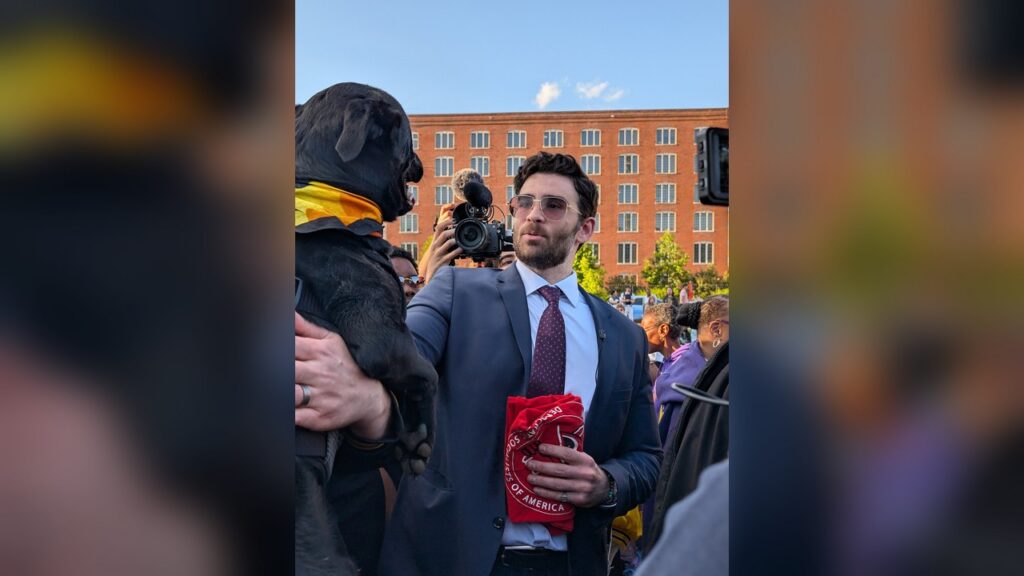
Piker himself made the sharpest observation in this affair, and it is one the Democratic Party should sit with: “If this had happened to Charlie Kirk or if this had happened to Ben Shapiro, this would be the number one news story on Fox News for a month.” He is correct. The asymmetry of outrage is not a bug in the system. It is the system.
 Junior Class, University of Wyoming (No restrictions) via Wikimedia Commons
The question is not whether Hasan Piker deserves a platform. No one has a right to be a featured university speaker, as Balta correctly noted. The question is whether a public university, under federal investigation and facing organized pressure, canceled an event for the reasons it claims or for the reasons that are obvious to anyone who has watched American institutions operate under regulatory threat. The literature on organizational behavior under compliance pressure is extensive and, at this point, largely descriptive. Universities do not need to be told to be cautious. They simply become cautious, and then they explain that they were being rigorous all along.
The rigor, one suspects, was never the problem. The rigor was the solution.