


The literature on coercive statecraft converges on a finding that should be banal but apparently needs restating: economic sanctions work, when they work at all, over time horizons measured in years, not weeks. The Drezner corpus, Pape’s critiques, the Hufbauer-Schott-Elliott dataset at the Peterson Institute, all point in the same direction. Sanctions require patience, institutional continuity, and a tolerance for ambiguity that borders on the monastic.
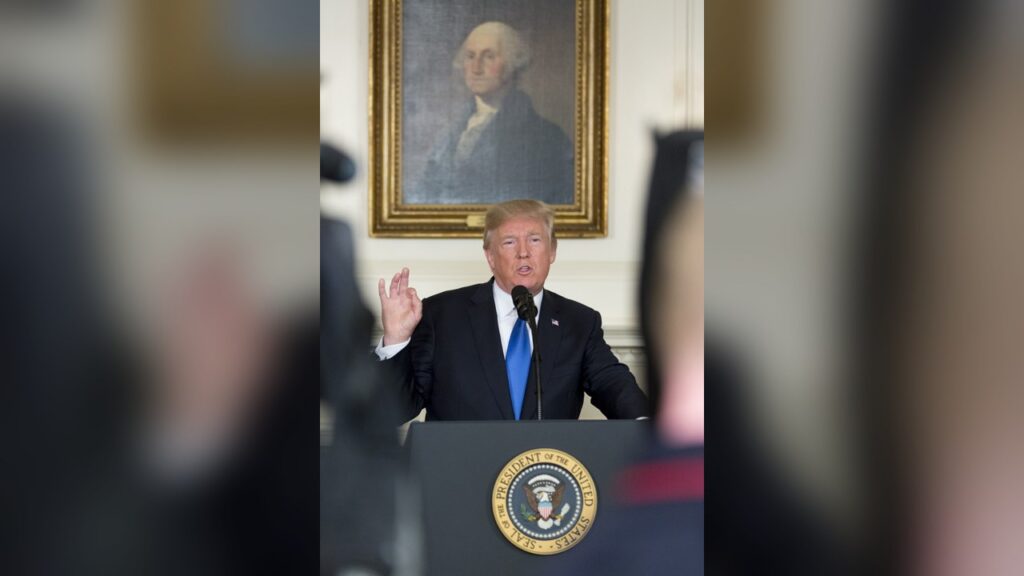
They require, in other words, precisely the qualities Donald Trump has spent his entire public life demonstrating he does not possess.
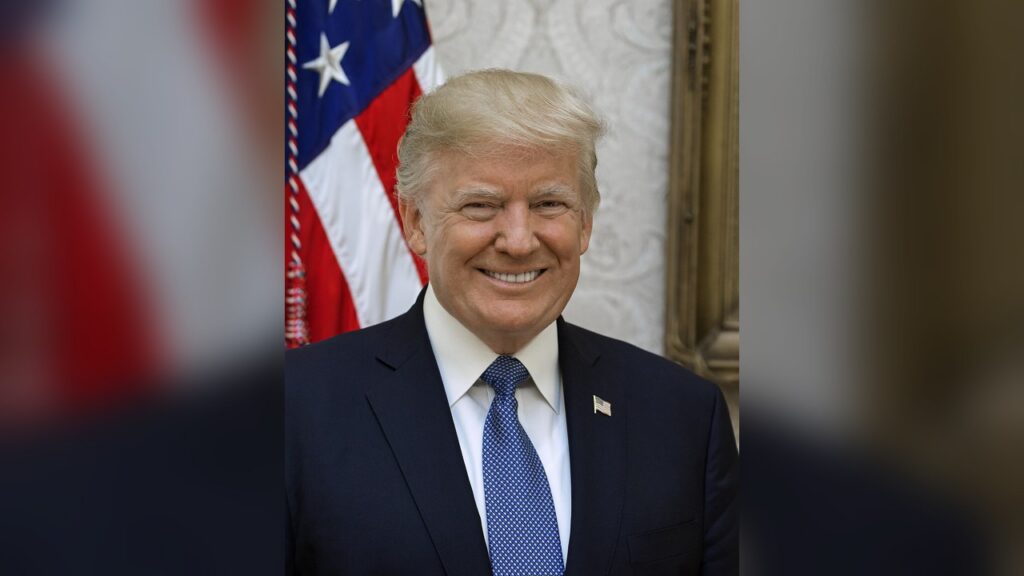 Shealeah Craighead (Public domain) via Wikimedia Commons
The president’s new Iran strategy, as reported in The Atlantic, is to do nothing and see if that works. This is not my characterization. It is the characterization of his own administration, conveyed through the anodyne language of “de-emphasizing both diplomacy and military action” in favor of a “wait-and-see approach” built on stepped-up sanctions and a naval blockade. The hope is that economic pressure will accomplish what five months of bombing, apocalyptic threats, and serially collapsed negotiations could not: force Tehran to reopen the Strait of Hormuz and end a war that the administration’s own supporters struggle to call anything other than a war of choice.
The strategy is not, in principle, indefensible. Maximum-pressure sanctions did constrain Iran’s economy during Trump’s first term, and the White House is reportedly showing the president data on soaring inflation and collapsing energy revenue. Treasury Secretary Scott Bessent has even assured Trump that the Strait of Hormuz will become “irrelevant” within two years, claiming up to 70 percent of transiting energy will eventually flow through underground pipelines. One notes, with the weariness of someone who has read too many infrastructure projections, that pipeline timelines in the Middle East are not typically measured in months, and that Bessent’s optimism serves a domestic political function rather than an analytical one.
But the deeper problem is not the strategy. The deeper problem is the man asked to execute it.
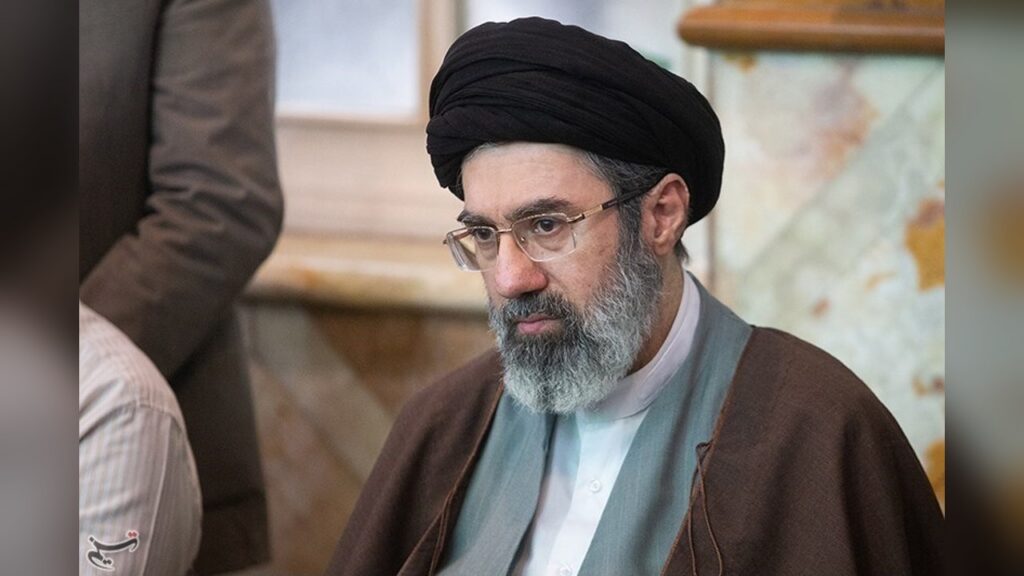 Mostafa Tehrani (CC BY 4.0) via Wikimedia Commons
Trump’s own advisers, speaking anonymously as they always do when discussing the president’s temperament, acknowledge that a single Truth Social post “fired off in anger” could derail the entire plan. This is not a hypothetical concern. On Saturday, the president posted that Iran had threatened to assassinate him and that 1,000 missiles were “Locked and Loaded” against the Islamic Republic. Hours later, Iran’s new supreme leader, Mojtaba Khamenei, vowed to avenge the killing of his father, Ayatollah Ali Khamenei, who died in the initial U.S. and Israeli strikes that began this war in late February. The son’s language was unequivocal: “This revenge is the will of our nation and must certainly be carried out.”
So the patience strategy is being tested in real time by a cycle of provocation and response that the president himself keeps fueling. Trump has also suggested he left standing orders for the military to destroy Iran “at levels they’ve never seen before” if he is assassinated, a “dead man’s switch” that, as Garrett Graff has patiently explained, has no legal mechanism in the U.S. system. If Trump is killed, the 25th Amendment transfers authority to Vice President JD Vance, who makes whatever call he chooses. There is no automatic retaliation protocol. The president appears to have confused a social media post with a constitutional framework.
Meanwhile, the material constraints are becoming impossible to ignore. Some U.S. missile defense stockpiles are at 20 percent of desired levels. An Iranian missile already slipped through defenses at a base in Jordan and detonated on a barracks housing American troops. The threat to the president was credible enough that the Secret Service smuggled him off a Qatari-gifted plane, which lacks standard defensive countermeasures, onto an older Air Force One jet via a catering truck. One does not need to be a structural realist to find something darkly farcical about a president who started a war of choice, depleted his own munitions, and now must be extracted from a NATO summit in a food service vehicle.
 Senator Tim Scott (Public domain) via Wikimedia Commons
The structural irony here is nearly perfect. The administration has arrived at a strategy, sanctions and blockade, that is the most institutionally sound option remaining, precisely because all the impulsive options have been exhausted. The bombing didn’t work. The threats didn’t work. The munitions are running low. The only tool left is the one that demands the temperament Trump most conspicuously lacks. And the midterm elections are in November, with no decline in energy costs on the horizon.
The regime in Tehran, it should be said, has demonstrated a capacity for endurance that has surprised U.S. intelligence at every turn. Iran was not supposed to close the strait. Iran was not supposed to absorb the economic pressure. Iran was not supposed to strike U.S. bases effectively. Each of these assumptions was wrong. The regime has survived sanctions before, and its new supreme leader is governing with the explicit mandate of avenging his father’s death. This is not a negotiating partner that will buckle because Scott Bessent showed the president a chart.
What we are watching, then, is not a strategy so much as a structural trap. The president has been cornered into patience by the exhaustion of every alternative, and the only question that matters is whether the architecture of restraint can hold against a man who has never been restrained by anything except the limits of his own attention span. The advisers are hoping the war slips from the headlines. The Iranians are hoping it doesn’t. And the rest of us are left to contemplate the fact that the stability of the Persian Gulf now depends on Donald Trump’s capacity for boredom.