


There is a concept in the institutionalist literature, perhaps most rigorously formulated by the political scientist Stephen Walt, that great powers do not lose wars because they lack the capacity to destroy. They lose wars because they cannot define what “winning” means in a way that survives contact with the timeline of domestic politics. We are watching this theorem execute itself in real time, and I confess a certain exhaustion at the necessity of pointing it out.
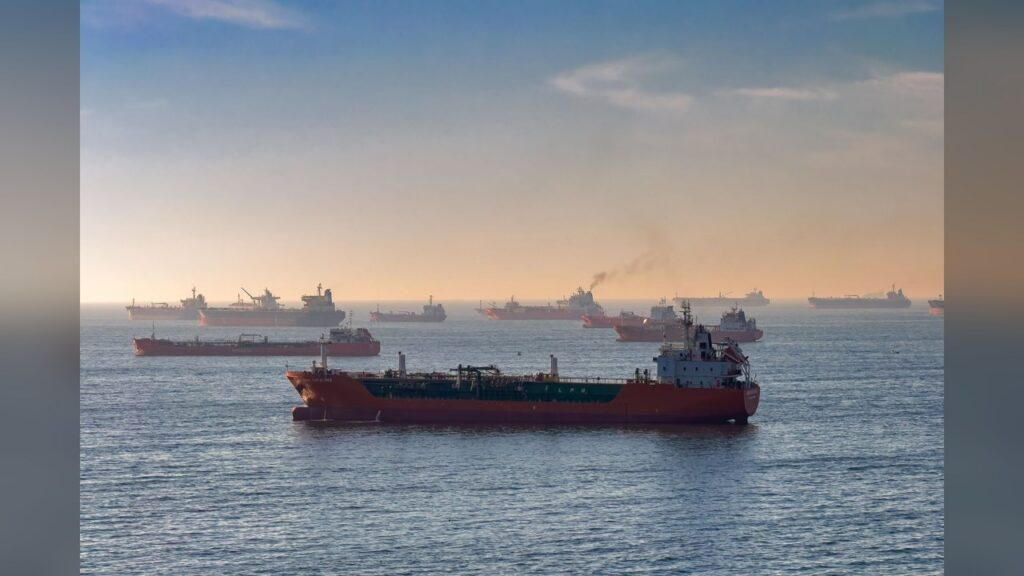
President Donald Trump has reportedly told his aides he is willing to end the military campaign against Iran even if the Strait of Hormuz remains largely closed. The Wall Street Journal, citing administration officials, reports that Trump and his team concluded a mission to physically reopen the waterway would extend beyond his self-imposed four-to-six-week window. So the president who launched this war to keep the world’s most critical oil chokepoint open is now prepared to declare victory and leave it shut. One struggles to locate the strategic logic, unless the strategic logic is that there is no strategic logic, only a news cycle.
 Shealeah Craighead (Public domain) via Wikimedia Commons
Let us be precise about what has happened. The Strait of Hormuz carries roughly a fifth of global oil consumption. Tehran blocked it in retaliation for the US-Israeli strikes. The US national average gasoline price crossed $4 a gallon on Monday for the first time in over three years, per GasBuddy data. The president’s response was to threaten, in his characteristic prose, to “blow up and completely obliterate all of their Electric Generating Plants, Oil Wells and Kharg Island (and possibly all desalinization plants!)” if the Strait is not “immediately ‘Open for Business.'” He then, according to his own aides, privately conceded he may end the war without it being open at all. The threat and the retreat arrived within the same news cycle. This is not a grand strategy. It is a man shouting at a tide.
The structural complications are, if anything, more damning than the rhetorical ones. The New York Times reports that the US-Israeli campaign’s decapitation of Iranian leadership has so fragmented Tehran’s decision-making apparatus that the officials who remain may not know what their own government is willing to concede. Trump, meanwhile, confirmed he is negotiating with parliament speaker Mohammad Bagher Ghalibaf, a former Islamic Revolutionary Guard Corps commander who has spent the war mocking Americans on social media. Trump called this “new and more reasonable” leadership. I will leave it to the reader to assess whether a man who has spent weeks issuing threats constitutes a reasonable interlocutor, or whether the president simply needed someone, anyone, to take the call.
And then there is Netanyahu, who told Newsmax the war is “definitely beyond the halfway point” in terms of missions but declined to put a schedule on its conclusion. “In terms of missions, not necessarily in terms of time,” he clarified, which is the sort of distinction that sounds meaningful until you realize it means the war ends when the war ends. The Israeli prime minister also voiced confidence the Islamic Republic would “collapse internally,” which is the same prediction various American administrations have offered about various adversarial regimes for decades, with a success rate that the empirical record does not flatter.
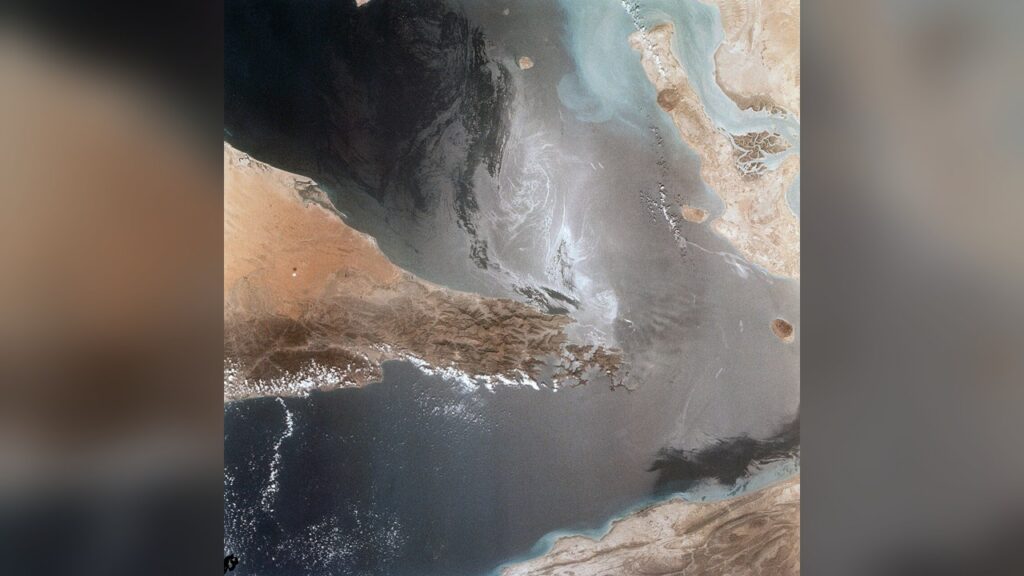 NASA (Public domain) via Wikimedia Commons
What we are observing is not a peace process. It is the collision of an American president’s attention span with a geopolitical problem that does not respect attention spans. Trump wants a deal within weeks. The Strait does not operate on weeks. Iran’s shattered command structure does not operate on weeks. The global oil market, which has already priced in the disruption, certainly does not operate on the president’s calendar. The systems here are larger than the man, and they will not be bullied into compliance by a Truth Social post.
The literature on truncated wars, from Korea onward, is unambiguous on one point: when a great power defines its exit by a domestic clock rather than by battlefield conditions, the adversary learns to wait. Iran’s remaining leadership, such as it is, has every incentive to run out the clock. Trump has, in effect, announced the terms of his own leverage’s expiration. The Strait stays closed. The gas prices stay high. The president declares progress. And the systems grind on, indifferent to the announcement.