


Funny how this works. For three years, the same intelligence agencies that couldn’t find WMDs in Iraq told us Vladimir Putin would never dare touch a NATO country because he was too busy grinding himself to pieces in Ukraine. Now, overnight, they’ve changed their minds. The Wall Street Journal reports that U.S. intelligence now believes Russia could attack a NATO member within weeks. Not years. Weeks. And the timing couldn’t be more perfect for the people who need you terrified.
Ask yourself who benefits. The Pentagon’s own munitions stockpiles are gutted. Patriot interceptors, THAAD systems, Stinger missiles, long-range precision munitions, all running low. Depleted by years of shipping everything to Ukraine and now by a shooting war with Iran that nobody voted for. Donald Trump himself said it out loud on August 6 when Zelensky came asking for more hardware: “We need missiles too.” That’s the president of the United States admitting the cupboard is bare. And the very next day, here comes a leaked intelligence assessment saying Putin might strike NATO this fall. You’d almost think somebody needed a headline to justify a massive emergency defense appropriation.
 Shealeah Craighead (Public domain) via Wikimedia Commons
The scenarios these officials float are vague enough to cover anything and specific enough to scare your grandmother. A cyberattack. A small land incursion. Unmarked armed groups occupying territory. False flag operations using Ukrainian-made drones to make it look like Kyiv attacked the Baltics. The timeline stretches from “this autumn” all the way to 2029, which is intelligence-community speak for “we have no idea but please keep the checks coming.” Lithuania’s defense minister, Robertas Kaunas, got on the radio to say the Kremlin needs “a new escalation, some kind of new victory.” Maybe. Or maybe Lithuania needs a reason to demand more NATO troops on its soil, which it has been doing for months.
Now, I’m not saying Russia is harmless. A Russian cruise missile did crash into a field near a Polish village last month, leaving a 10-meter crater 60 miles from the Ukraine border. An explosive-laden drone packed with Semtex turned up next to a Ukrainian cargo plane at Leipzig airport in Germany. A Russian warship conducted a live-fire exercise in the English Channel near Plymouth. UK Defence Secretary Wes Streeting called it the “tip of the iceberg.” These are real incidents. But notice the pattern: every one of them is ambiguous enough to be called an accident or a provocation depending on who’s doing the talking. A missile lands in a field. A drone shows up at an airport. A warship fires guns in international waters. Each one gets folded into a narrative about imminent war, and each time the solution is the same. More money. More weapons. More deference to the experts who keep getting the big calls wrong.
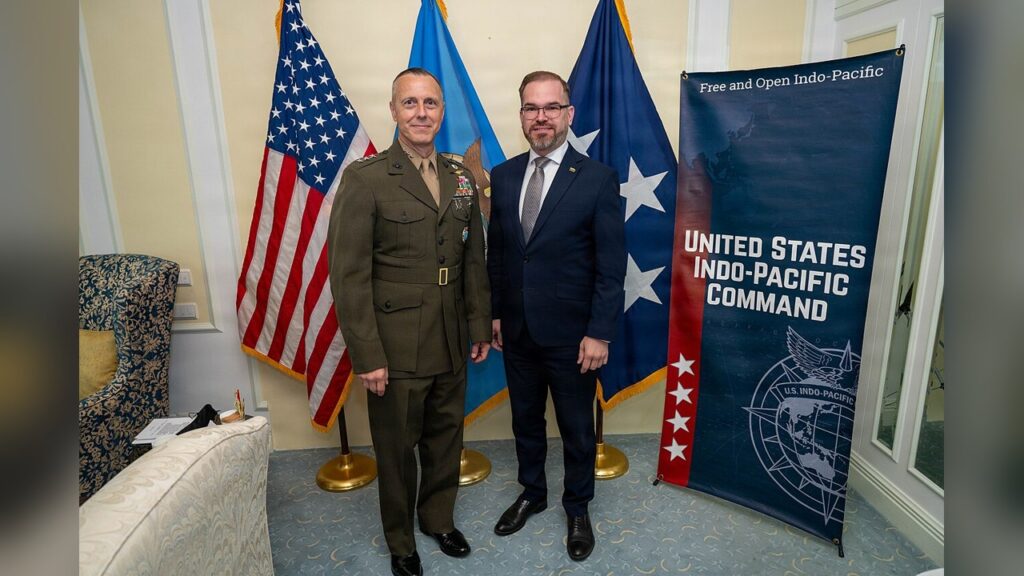 U.S. Navy photo by Petty Officer 1st Class Ryan McLearnon (Public domain) via Wikimedia Commons
Germany’s army chief, Lieutenant General Christian Freuding, warned back in June that Russia could strike NATO within three years. Now the Americans have telescoped that to “weeks.” The same agencies that spent two years insisting Putin was boxed in and would never risk it have suddenly decided he’s cornered and therefore more dangerous. Which is it? Is he weak or is he about to roll tanks into Estonia? They want it both ways. He’s simultaneously losing in Ukraine and poised to take on 32 nations. Pick a story and stick with it.
On August 5, Russia launched 24 ballistic missiles, four hypersonic missiles, and 115 drones at Kyiv. Seventeen people died. Not one missile was intercepted. Allied air defense supplies to Ukraine dropped by two-thirds in the first half of this year compared to 2025. That is a real crisis. But it’s a crisis of our own making, because the same establishment that emptied the shelves is now telling you the wolf is at the door and only a blank check can save you.
 David Woolfall (CC BY 3.0) via Wikimedia Commons
The little guy always gets the bill. The experts always get the budget. And the official story never quite adds up.